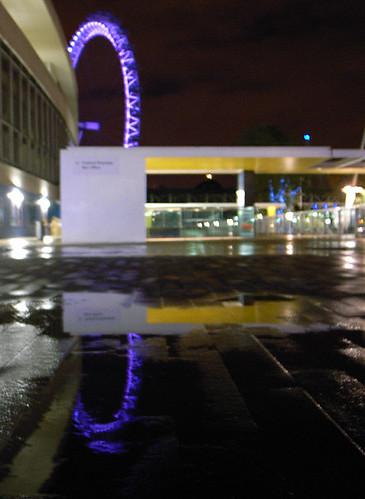
South bank rain

south bank rain

This is a test of the dinky “blog this” facility in flickr which I’ve never thought to use before. In theory this image should be 500 px wide and centred with this text underneath it.

The picture itself was taken the other night after the Lachenmann concert. I emerged, floating, from the QEH and the rain was soft and gentle, the lights beautiful. Although I have no idea what that structure is which, in the cold light of day, looks distressingly like a petrol station.

Oh what a beautiful morning…

…oh what a beautiful day. Yesterday, now. But even the passing of midnight hasn’t lessened the effect.

I twirl across the mountain meadow warbling a happy song, regardless of the fact that the song is in Oklahoma and the mountain is in Austria.

How extraordinary to feel happy. Really, it is extra to the ordinary. Such a surprise, a novel sensation. Almost frightening in its intensity.

And what can have caused this? I have absolutely no idea. It could have been the weather – sunny outside and not so cold inside hunched over the keyboard that I had to wear sheepskin boots and two fleeces. Maybe it was the long sleep – I didn’t wake up until after 11am. But both these conditions have been met on other occasions and not resulted in joy.

There is no extrinsic cause I can discern for this mood. And intrinsic? How could I tell? The chemistry of my brain is a mystery to me.

I’ve been enjoying it like a pebble off the beach sun-warm in my hand, small and flecked with surprising colours. And the day has just got better and better. Superb music redolent of the time I finally escaped from home; work achieved; laughter with friends; children delightful; far-away friends phoning out of the blue; more superb (and utterly appropriate) music.

The only photograph I have from the day is this one, taken on my phone outside the post office.

doll bike seat

The doll reminded me of the only doll I ever loved whom I called, who knows why, Pandora. I remember sitting under the ironing board in the kitchen with Pandora in my arms while my pressed clothes above my head. In a patch of sunlight.

Ca existe!

The podcast for which I spoke to Alain de Botton (see Wednesday evening) is up at the openDemocracy website.

It’s available for listening or download here. Alain makes his appearance at about 14’00 in. Or, to look at it from the other end, at about 5’00 out.

It was very enjoyable doing “radio” again and the whole podcasting phenomenon is highly exciting.

Helmut Lachenmann

“If this man doesn’t meditate”, I thought, “I’ll eat my hat”.

It was a randomly-caught radio programme – Music Matters on Radio 3 – which sparked thoughts of cerebellarophagy. It contained an item about the modern composer Helmut Lachenmann which I found so intriguing I saved it for posterity (please download and listen if you’re interested – at 11 minutes it’s a bandwidth hog).

The bit that particularly caught my ear was this, said by cellist Gabriella Swallow about the composer with whom she’s been working closely:

Every second counts with Lachenmann, I mean he’s always listening and I think this music is incredibly well heard. He even uses it as a demonstration – he tells you to stop talking… and he says ‘listen’. And you just listen for a minute and there’s a fan or a light or something, a little hum, and he says ‘that’s beautiful to me’. And it’s just this incredible sound world he engages you in.

This reminded me so strongly of the kind of meditation practice where you lose yourself in the universe of sound:

Listening meditation works in a different way from breath or sensation meditation. We do not focus inwardly but outwardly in a wide-open manner. We do not create nor imagine sounds. We wait for them to come to us. Any sounds will do — the roar of a car, the barking of a dog, the twittering of a bird. We listen attentively to any sounds that might occur with a non-grasping attitude. We open up to the music of the world and of life. We do not name, conjecture or identify the sounds. We just listen as widely and openly as we can at the sounds themselves. If there are no sounds we just listen to silence and its special hum. In listening meditation we cultivate an open and spacious attitude which waits quietly for the unknown without fears or expectations.

How could I miss what turned out to be the last concert in a series called Transcendent which was being held at the Queen Elizabeth Hall the very next night? Obviously I couldn’t.

pre-concert talk

That’s Lachenmann on the right having a pre-concert chat with journalist Tom Service, the host of the radio programme clip above. Nothing said in their exchange on stage lessened my sense that hearing this music would be in some way akin to listening meditation, and for me that was indeed the case – the sighs, whispers, hums, rattles, clinks, growls, squeaks, pops and twitters resembled the range of sounds which arise, mingle and fade away across the aural canvas of contemplation.

And of course it was also profoundly unlike a listening meditation because by its nature it was ordered, choreographed, wrought. And I couldn’t entirely lose myself in the sounds because the visual stimuli were so strong. The intense concentration on the faces of the musicians, the extraordinary things they did to their instruments to make the sound required by what must be an extraordinary score. What, to take one example among hundreds, is the notation for playing a clarinet by removing the mouthpiece and banging the top with the palm of your hand?

Thought followed on thought. Does Lachenmann explore the sonic possibilities of each instrument himself or in collaboration with individuals who can play them? Why is it important to make these sounds within (mostly) the constraints of the traditional instruments of the orchestra? I thought how different each experience of each performance or recording would be because of the sonic environment in which it is heard and whether that awareness was part of the intention of the composition.

At the end of the first piece there was a tingling in the air for many seconds of breath-held silence while the conductor remained motionless, semi-bowed, arms flung outwards, before he finally straightened and allowed the audience to applaud, amongst us the clearly delighted composer kissing his fingers to the musicians.

It was now or never.

As people dispersed slowly for the interval I bounded up the steps, planted myself as near to the lionised composer as I could get and asked, politely but firmly.

“Excuse me, do you meditate?”

Continue reading “Helmut Lachenmann”

Leaving with knobs on

leaving with knobs on

How could I miss this the other day? It’s the textured bit of pavement round the corner from my house which I stand on at least daily waiting for the lights at the pedestrian crossing to change.

Colour this time, and showing the tea-stain shade which adds credence to Dave ‘s surmise as to the formation of these marks. I can’t find any further information about it myself.

I think I missed it (this particular print) because it simply wasn’t there. My guess is that the process (whatever it is) must happen quite quickly given the high levels of wind and pedestrian disturbance on the pavement concerned.

Plant a tree in '73

That was the slogan. I’m old enough to remember it, trays of tiny trees ready for our small fingers to thrust into holes dug by others.

National Tree Planting Year 1973 (with its slogan of “Plant a Tree in ’73”) led to the founding of the Tree Council to bring together organisations working for trees. It ran the first National Tree Week in 1975. Now up to a million trees are planted each year as a result of this winter festival.

I’ve planted a tree in the sidebar – an attractive button linking to the monthly Festival of the Trees.

If you get wood and like hugging it, or just delight in the arboreal, you too can have such a gizmo on your page. Just copy the code below and paste it into your blog:

Festival of the Trees

This month’s carnival coincides with the UK’s National Tree Week, the start of the tree planting season and a nationwide celebration of trees and woods. So it would be great if there were lots of UK entries!

Submit your tree-related links to this month’s gracious host – Jade of Arboreality – by November 29. Her email is: jadeblackwater [at] brainripples [dot] com, and remember to put “Festival of the Trees” in the subject line.

Don’t stint with the linky-love – suggestions needn’t be to your own blog alone, if you find something on the web that you think tree fans should see please put that forward too.

Plant a tree in ’73

That was the slogan. I’m old enough to remember it, trays of tiny trees ready for our small fingers to thrust into holes dug by others.

National Tree Planting Year 1973 (with its slogan of “Plant a Tree in ’73”) led to the founding of the Tree Council to bring together organisations working for trees. It ran the first National Tree Week in 1975. Now up to a million trees are planted each year as a result of this winter festival.

I’ve planted a tree in the sidebar – an attractive button linking to the monthly Festival of the Trees.

If you get wood and like hugging it, or just delight in the arboreal, you too can have such a gizmo on your page. Just copy the code below and paste it into your blog:

Festival of the Trees

This month’s carnival coincides with the UK’s National Tree Week, the start of the tree planting season and a nationwide celebration of trees and woods. So it would be great if there were lots of UK entries!

Submit your tree-related links to this month’s gracious host – Jade of Arboreality – by November 29. Her email is: jadeblackwater [at] brainripples [dot] com, and remember to put “Festival of the Trees” in the subject line.

Don’t stint with the linky-love – suggestions needn’t be to your own blog alone, if you find something on the web that you think tree fans should see please put that forward too.

Leaving

The streets are paved with the ghosts of leaves, faint shadowed fadings where once colour was.

leaving1

Maybe it is a chemical process akin to that used by some to explain the image on the Turin shroud.

leaving2

Neither water nor oil, flowing and filming across the surfaces, are sufficient swiftly to remove these signs. I have not tried wine.

leaving3

Do these atoms bonded to brick and bitumen ever return in recycled spring leaf resurrection?

leaving4

My mother died, about a year ago. This off focus imprecision still stains. Black bonded scar no scrubbing cleans.

Happy techno gadget love joy

When your day starts out crap there’s nothing like receiving a small (and not very expensive) bit of kit in the post.

Which, you will have correctly inferred, is what happened to me today. One of these babies plopped onto the doormat in a padded envelope. And that’s because I was so excited by the pre-launch spec that I pre-ordered.

It arrived while I was conversing (via IM) with my colleague the similarly techno-joyful Georgia, and she demanded proof of its pudding.

Thus it was that while visiting another former colleague (see previous entry for more), Kevin Anderson, who’s also a good friend of Global Voices, I shoved my new toy under his nose for demonstration purposes, reviewable here.

Not bad for something so small, I think you’ll agree. And at the low quality setting. I’m highly pleased.

And while there I was also able to take some pictures for Jeremy of the Ken Saro-Wiwa memorial sculpture about which he writes here and then here.

Hi Jeremy! Hope they give some idea of how it’s bedding down in its surroundings.

ksw1

ksw2

ksw3

ksw4