Happy techno gadget love joy

When your day starts out crap there’s nothing like receiving a small (and not very expensive) bit of kit in the post.

Which, you will have correctly inferred, is what happened to me today. One of these babies plopped onto the doormat in a padded envelope. And that’s because I was so excited by the pre-launch spec that I pre-ordered.

It arrived while I was conversing (via IM) with my colleague the similarly techno-joyful Georgia, and she demanded proof of its pudding.

Thus it was that while visiting another former colleague (see previous entry for more), Kevin Anderson, who’s also a good friend of Global Voices, I shoved my new toy under his nose for demonstration purposes, reviewable here.

Not bad for something so small, I think you’ll agree. And at the low quality setting. I’m highly pleased.

And while there I was also able to take some pictures for Jeremy of the Ken Saro-Wiwa memorial sculpture about which he writes here and then here.

Hi Jeremy! Hope they give some idea of how it’s bedding down in its surroundings.

ksw1

ksw2

ksw3

ksw4

Luminous?

This is an experiment.

layered tree

Trying to capture the luminosity of the low late autumn sun on the changing multi-coloured leaves, the shadow across the foliage.

I took the same picture at three different exposures – correct and -1 and +1. I then used the over-exposed picture as the baseline and layered the other two on top at 75% opacity each.

Of course a series of hand-held shots of something which by its very nature is shifting around a lot is perhaps not the ideal first attempt at this technique which relies on being able to align exactly similar images one on top of the other. But I think the result is pleasing nonetheless.

Below the fold I’ve lined up small versions of the final composite alongside the three constituent images which have all been treated in exactly the same way in order to compare the results.

What do you think, does it work? or is it, apart from the slight cropping, indistinguishable from the correctly exposed version?

Continue reading “Luminous?”

Festival of the Trees #5

I’ve had such fun reading through and organising all the submissions. I hope you enjoy them too. Most had an accompanying illustration. For the few that didn’t I’ve selected something I thought appropriate. Please, posters concerned, let me know if you have any objection.

downpour.jpg My own contribution, and that of my two helpers pictured left, is some tree audio. Friend H and son A kicked through drifts of dry leaves, pushed past brittle foliage on branches, snapped twigs and stood (and crouched) with great forbearance while I recorded the sudden downpour thrashing on the leaves. Thank you H and A for the sound of trees!
Yes, suddenly, it’s autumn, as Bev notes on Burning Silo.
Bear creek and soft maple leaves. Larry Ayers views Bear Creek And Its Trees from ground level to get the full carpet-effct of the fallen leaves. His dog Tucker looked on tolerantly at this behaviour. Later in his walk he finds vast leaves on a tiny sycamore sapling and speculate on the possible cause of their scale.
bigleaf.jpg And while we’re on the subject of the outsized, big leaf maple is the self-explanatory title of a post by the Dharma Bums. They’re sweet too, apparently. Their sap. The ones with big leaves.
A small leaf here, but one of many Fallen – leaves, death, seduction and the tempted Eve are woven together by Lorianne at Hoarded Ordinaries.
mountain ash over the arbor Death too haunts Sharon Brogan’s Snapshot Poem 04 October 2006 at Watermark. Yet I can’t help thinking that the bright scarlet-orange of the mountain ash berries in her picture show there’s brightness as well.
Backlit_lvs5_low_res Colour, form and light – Backlit Ninebark by the botanizing Larry Hufford.
swamp.jpg The frequent rains have enlarged the local swamps and the still water mirrors the emptiness above writes BodySoulSpirit in Family trees in October. She posts three images of trees from three different family members and muses on their symbolism.
In Understory Lorianne of Hoarded Ordinaries raises her eyes to the lower levels and honours the hangers-on.
leaves.jpg So why do leaves change colour and get pushed off their parent trees? I thought I knew, but recent research as outlined by Jeremy in A Festival of Leaves threatens to overturn the received wisdom of my school biology lessons. Read more of Jeremy’s science writing at the Voltage Gate.
mushroom.jpg Jade of Arboreality (and the host of this Festival next month) has been Playing in the Pocono Forests and shows us it’s not only leaves that are in ruddy colour.
Mushrooms_1 More mycology at Broad Meadow Brook, as seen by Leslee of 3rd House Journal This trunk with its mushroom footpegs looks like a ladder.
gspruce.jpg A sunset colour here, but perennial not autumnal. Joe Kissell presents The Golden Spruce – Tragic fall of a legendary tree posted at Interesting Thing of the Day. A highly unusual Sitka Spruce tree in British Columbia had golden needles and a conical shape, and was revered by nearby indigenous people. It was cut down by a logger-turned-environmentalist in a bizarre twist of illogic.
Another dead tree here, but what a whopper! For the story of this driftwood read Bev’s entry on Burning Silo.
fraserfir.jpg From gone to going… John Ruberry of Marathon Pundit was at Great Smoky Mountains National Park and found bad news for Fraser Firs.
needles.jpg Needles drop too… in this case the needles of the Pinus Strobus. As well as pictures Cindy of Riverrim also gives a useful tip for measuring the approximate height of a tree.
krummholz.jpg Butuki’s post The Lungs of the Mountain God (at Laughing Knees) is included here for the beautiful pictures of larch and elfinwood and creeping pine included in it. Read it too, for the exquisite writing of the account of a walk (walk?!) up Kurobe Peak and the non-tree-related pictures. The shot chosen to represent the post here is called “Kurobe krummholz” and, curious, I wanted to know what a krummholz is. What an excellent word.
Equisetum_guttation Another great word, another great picture and another great entry from Larry Hufford at botanizing: The guttating horsetail. The post qualifies for inclusion because of its references to the now-extinct tree horsetails, in case you were wondering. If, like me, you hadn’t come across guttation, read to the end to find out what it is. And read the comments to find out why the horsetail makes an excellent pan-scrubber.
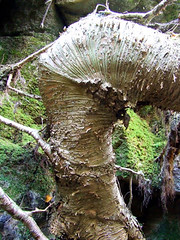
This weirdly-angled trunk is a yellow birch, one of several photographed by Dave Bonta of Via Negativa on his recent return to Bear Heaven in West Virginia’s Monongahela National Forest. He mentions its orogenous zone in passing as well as a legendary purple dye known as orchil. More new words for my list. Although Dave found some aspects of the trip disappointing his photographs never fail to delight. For the swiftly-connected there’s a slideshow here.
Maracas Beach, border= What a spectacular view! Find out in Appreciating Nature why for year Nneka just couldn’t appreciate it, as posted at Balanced Life Center.
mango tree Despite loving climbing trees and loving mangoes and having been in places with an abundance of mango trees I’ve never actually been in the branches of one. Now I know what I’m missing thanks to the poem Midday at Very Like A Whale. Mmmmmm. Lick that juice before the bees find you.
At Naturally Connected Wendy tells us why Burlingame calls itself the “City of Trees” and shows us how large “heritage” trees are protected – wherever they may be growing.
cornus.jpg Here’s another big tree – sent in by Julian of Bubble Brothers. The post is called Gather ye rosebuds, &c, – endangered species and concerns both this majestic Cornus kousa as well as an apparent wine-lake. The latter is related to Julian’s current job as a wine merchant. In his submission he says I’m certainly no photographer, and wasn’t able to make gardening pay, but here’s a tree that takes some of the sting out of having to serve Mammon. Plant ya now, dig ya later! I imagine the contents of Mammon’s bottles are quite efficacious in sting-relief too.
tane-mahuta1.JPG Tane mahuta is the last and perhaps the biggest of our big tree section. The god of the forest, the son of the sky father and earth mother, he ripped them apart allowing life to flourish. Lucy Kempton met the forest god’s forest incarnation while in New Zealand, and also found his grandeur in a rather more prosaic setting.
In this section we see some entries where words are foremost, starting with the Ballad of Penelope from Alan Van Dine of Light Verse for a Heavy Universe. Penelope dreams of finery while sprucelike, she lingers silently, contemplating the sorry fates of family members. Her story has a happy ending. Well, I think it does. But I can’t be sure.
bonsaicrabapple.jpg One poet highlights another – Juliet Wilson posts Three haiku on Trees by Sandy Hiss on her blog Bolts of Silk.
bamboo.jpg Read A landscape of holes where things once were. Chris Clarke writes at Creek Running North and he’s one of the best writers on the web. This post transcends summary by me. Just read it.
seagulls.jpg This last entry isn’t really about trees at all. It’s actually about the River Ribble in the north of England. I’ve included it for three reasons – firstly the delightful drawing of the seagulls and the sun making friends which contains trees; secondly it’s a piece of good environmental news and thirdly the blog links to Global Voices. I’m the host. I’m allowed to be biased.

The next host will be Arboreality – Tree Blogging. Send links to Jade by email: jadeblackwater [at] brainripples [dot] com to arrive with her no later than Nov. 29

Trees emerging… soon

Rainbow at sunset

These trees are disappearing into the gloom of an autumn sunset and not even the rainbow can engolden them.

But there are trees great (some very great) and small waving in the wings. Leaves of many colours (and sizes) coating land and water. Pot-scourers, pining pines, pricey purple, poetry, prose, even some very sibilant sound.

If you want to join in the Festival of the Trees send a link to your arborial entry by the close of day, October 30th, to festival [dot] trees [at] gmail [dot] com.

Leaving and returning

I posted these pictures late last night, very tired, and this morning think they probably need some explanation.

They were taken on the coach from Fredrikstad to Oslo airport.

The first is of the young woman sitting across the aisle from me. She and two friends were heading off, somewhere, full of excitement and laughter, energy and optimism.

leaving-home.jpg

The second is me.

heading-home.jpg

Yes, I am neither young nor full of energy (old and knackered!); I am not launching on new adventures. But although I might appear melancholy “thoughtful” would be more accurate – I’m listening to the divine Joan As Police Woman in concert in Amsterdam. Superb, despite the heavy cold she picked up in England.

And I’m optimistic and excited having, I think, succeeded in enthusing a new group of people about the current wonders of the Global Voices project and its future potential.

I’ve spent a lot of time mourning the young, glossy, happy and excited, energetic and optimistic self I never had/was. It changes and achieves nothing. Grasping and inhabiting the present is full of wonder.

Why I am not an uber blogger

Well there are no doubt many, many reasons. But what I’m thinking of here is my colleague Ethan who went to the Pop!Tech 2006 conference and appeared to manage to blog the entire event verbatim, in real time, with witty observations and links to and discussions of others’ coverage. How does he do that?

I, on the other hand, at a small and intimate conference in Norway, find myself far more inclined to blog about the picture in the main space at the Norwegian Institute of Journalism. Here it is, all four panels.

crows.jpg

Now I find this rather ominous. Crows are considered birds of ill omen in many cultures across the globe and the bringer of the news of death.

Anyway, let’s get a little closer to the bird on the right of the picture…

crow.jpg

… still can’t see it? let’s go right close up to that wing…

wing.jpg

Yes. The harbinger of doom, the portent of death is composed of…. news(papers).

UPDATE Had I actually read through the above Wikipedia link to the end I might have worked out what I have now been told, which is that these birds are actually Hugin and Munin, raven servants to the chief god of Scandinavian mythology:

Hugin and Munin travel the world bearing news and information to Odin. Hugin is “thought” and Munin is “memory”. They are sent out at dawn to gather information and return in the evening. They perch on the god’s shoulders and whisper the news into his ears.

This sounds too much like the secret police for comfort so despite the greater relevance to journalism I still think the artist is subverting the profession. /update

So that distraction explains why I haven’t written up my notes to the (very interesting) afternoon sessions about journalism in Africa. The unvarnished outline appears, for the record, below the fold.

Continue reading “Why I am not an uber blogger”

Tane mahuta

A guest post from the as-yet blogless Lucy Kempton for the forthcoming Festival of the Trees.

Meeting Tane mahuta was one of those jaw-dropping, lump-in-the throat moments.

In Maori cosmology, Tane Mahuta is the god of the forest, the son of the sky father and earth mother, who tore his parents apart, breaking their primal embrace, bringing light, air and space, so allowing life to flourish.

tane-mahuta1.JPG

This avatar of Tane is a 2000 year old kauri tree in Northland, New Zealand. It is impossible to convey the scale of these trees in a photo; their feeding roots are near the surface and delicate, and you cannot approach them too closely, which seems only appropriately respectful. The movement of the dappled forest light on the texture of the bark seems to be emanating from the tree rather than simply reflected, and a whole unattainable world exists in the branches.

tane-mahuta-2.JPG

Some days later, walking on a headland overlooking the Pacific, I met Tane Mahuta again in microcosm, this time in this lichen covered old fence post!

They don't make 'em like they used to

I was too young to see The Ascent of Man by Jacob Bronowski when it was first broadcast. But I am definitely old enough to shake my head and tut sadly about the appalling decline in standards of science programming since my youth. Look at this for a profound and thought-provoking example of engaging with the audience without the slightest sign of patronising its collective intellect.

This reminds me of a fascinating conversation I had with my friend the artist Ruth Maclennan about her work We saw it – like a flash which looks at the presentation of science on BBC television between 1954 and 2003. She confirmed, from her experience of watching hundreds of hours of such programmes, that the standard has indeed declined alarmingly over the years.

I came across the link for this powerful piece of programming on Pharyngula, part of the Seed Media Group : Science is Culture, and whilst poking around also found the excellent blog SEED – seeking dialogue between art and science which despite its name is not as far as I can work out connected to the Media Group.