…complaining about the weather…

…but it’s not as tedious as the weather itself.

a negative capability scrapbook
The former are good for the bowel. The latter is not advisable in the case of anti-depressents.
Why then have I abruptly stopped taking my medication?
No pills for a week, a chemical half-life of 36 hours. This means 94% of the active ingredient has left the bloodstream. So far I’m not noticing any obvious changes other than noticing that I’m noticing. No SSRI discontinuation symptoms popping up, no worsening of existing “symptoms” which also fall under discontinuation effects.
So far so good, but arriving at this point without conscious planning is, now it has my full attention, a bit strange. I’ve been told several times by different medical types that it’s unlikely I’ll ever not need at least a “maintenance” dose and I’ve been quite untroubled by the thought of life-long medication. Far, far, far rather that than illness.
I wonder whether it’s my experience of the efficacy of mindfulness and meditation which is behind this. Not as blissed-out alternative to reality (although the very rare moments of samadhi, blissful ultra-reality, are a fantastic incentive to keep going) but as a toolkit for living, weathering the “stings and sorrows” of life, as this NYT article memorably terms them.
Or of course it could be driven by something as trivial as the desire to lose weight, in which case a healthy dose of exercise would be a far better option.
Today was the first day when I consciously didn’t take the pills rather than apparently simply forgetting. I’m interested to see what happens next. But they’re still safely in the cupboard (so the cat, who finds the rattling noise they make irresistible, doesn’t play with and accidentally ingest them) ready to be popped should the need arise.
Up at sparrow’s fart to drive down to Whitstable with Nina, Arun, Neha and Maizy. Nina drove, I subdued Maizy in the passenger seat and Neha in the back rose heroically to the initially alarming instruction to give Arun his bottle when he got hungry.

He’s a beautiful smiling-gurgling-laughing boy. Which is just what you need if you’re a single parent (speaking from experience).

Neha is already instructing him on the finer points of philosophy.
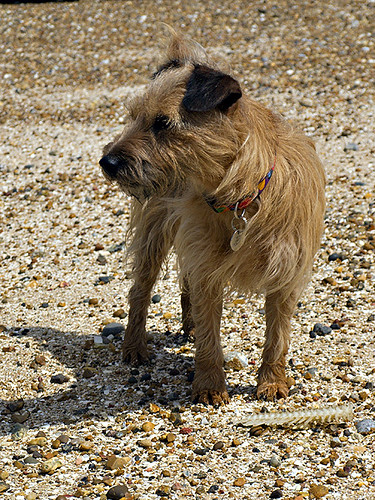
Maizy managed to contain her jealousy (didn’t grab his head in her jaws and drag him around the ground as she does with the cat… which was a relief.) She confined herself to locate the smelliest fish carcasses and offal and rolling in them in order to perfume the car on the return journey. We had a superb meal in the restaurant above the fish market from where we could see a fisherman mending his net

and the gravel processing plant which obscured any further the view of the sea.

Unfortunately we then had to belt back to London like shit off a shovel because of my rather urgent and complicated domestic arrangements involving three children, seven adults and four different suppers.
Interesting to turn from musings on how journalists might best pluck goodies from the strands of the wondrous world-wide webbing to see that some are finding it a highly nourishing activity already.
How cheerfully he seems to grin,
How neatly spreads his claws,
And welcomes little fishes in,
With gently smiling jaws!
Liz Hunt is a journalist who currently inhabits the waters of the Daily Telegraph newspaper and her information acquisition techniques appears to include, to one blogger at least, plagiarism:
Attempting to pass off someone else’s words or ideas as your own without proper attribution or acknowledgment. In both journalism and academia, this is akin to theft. Examples: Copying in whole or in part a published article or another student’s paper, borrowing language or concepts, lifting quotes or failing to use quotation marks where appropriate.
Journalistic plagiarism ranges from including one or two sentences copied from another newspaper without attribution, to more serious cases, such as copying an entire paragraph or story… The ease of copying electronic text from the Internet has lured a number of reporters into acts of plagiarism; column writers have been caught ‘cutting and pasting’ articles and text from a number of websites…
Koranteng Ofosu-Amaah wrote one of his characteristically wide-ranging, erudite and entertaining blog posts entitled Bags and Stamps. It weaves together a number of strands around the subject of those outsized, woven plastic, plaid-printed flimsily-zipped containers known in west Africa as “Ghana must go” bags. He calls them “an object lesson in the fluidity of ideas” in an essay which touches on, among many other things, the subject of plagiarism. That was on 13 April this year.
Some time later, on 2 June to be precise, Liz Hunt wrote a piece in the opinion section of the Daily Telegraph entitled Immigrants have bags of ambition. It is a short piece, however it seems that Koranteng’s ideas had been fluid enough to percolate into her small container. Let’s note at this stage that Koranteng’s blog states, at the bottom of each page, that the contents are copyright, a move which protects it under UK law. Also that the Telegraph group itself is no stranger to the importance of attribution as regards the re-use of their own content on the internet:
Please provide attribution to telegraph.co.uk in relation to the RSS feeds either in text form: “telegraph.co.uk” or by using the telegraph.co.uk graphic (included in the feeds).
The day after Liz Hunt’s article appeared Koranteng wrote a letter to the newspaper’s editors: A Plagiarism in Plaid in which he links to a detailed textual analysis of his essay next to her article. There has been an e-mail response from Liz Hunt in which she says:
I am happy to organise a link to your blog IF you will extend the same courtesy to my (unedited) defence against your accusation which I refute.
This he has done but there’s no sign of any link on the article back to his blog, and a week after the original mail there’s still no response from the editors. Incidents like this are important for a number of reasons. Firstly the obvious… plagiarism is against journalistic ethics; it brings discredit on both the individual and the organisation and damages their credibility and reputation. Trust and authenticity are qualities difficult to acquire and easy to lose but much prized by media organisations in the global proliferation of internet information sources. Accusations should be taken seriously by both journalists and editors.
Secondly it has implications for the future of information gathering and exchange on the internet. Mainstream media news organisations are increasingly alert to unacknowledged re-use of their material. They watch each others’ output for evidence of unacknowledged borrowings. News agencies similarly monitor media outlets to ensure their material appears with appropriate attribution. It is hardly surprising that individual writers do the same. The rules, such as they are, should apply to all.
Thirdly one of the great beauties of text on the internet is the ability to make hyperlinks. It enriches the experience of communication for both producers and consumers. It is the technology which is shaping the transmission and reception of information, away from a top-down model to a more collaborative and conversational paradigm.
Searching for “telegraph” and “plagiarism” on google brings up more than a quarter of a million hits including this previous example of stealing an entire blog post wholesale. However there are already two references to Koranteng’s post in the first ten results. Plagiarism or sloppy attribution, whatever one cares to call the importation of material, including an unusual spelling mistake, requires some kind of response.
Steve Buttry of the American Press Institute, whose article I linked to above, says the following:
I’m willing to call small-scale plagiarism something less damning and punish it with something less than the public flogging that has become standard.
But given those stakes and all that attention to the issue, I find it hard to believe a journalist would copy and paste from another source without first putting quotation marks and attribution into the story (as I did when I cut and pasted the plagiarism definitions above).
If someone pleads sloppy attribution, I would thoroughly research that reporter’s past stories and thoroughly vet future stories. I’m skeptical and I’m not cutting much slack.
Our credibility is precious and a sloppy journalist is hardly better than a crooked journalist.
I’m sure Koranteng doesn’t want a public flogging. Or damages. He just wants an explanation and an attribution from the editors. Is that so very, very difficult?
Good grief. There’s wifi in the campsite. It rained a lot. Torrentially. Then it hailed. Then, at dusk, it stopped and some people went fishing.

The van has such excellent ventilation.

Is it any wonder my feet get so cold when driving?
Thank goodness for Adnams beer.
She’s Hoarding her Ordinaries in a slightly different place after a nasty outbreak of the white screen of death. Go for your daily fix of insight and beauty to http://hoardedordinaries.wordpress.com/ – Hoarded Ordinaries, now with added WordPress loveliness.
So. I’m to take part in an internal BBC discussion tomorrow morning. The “100 top editors and managers of BBC global news” apparently get together for a monthly breakfast meeting to discuss… stuff. Tomorrow the topic is defined by two questions – “what is the best journalism in the world?” and “what will journalism look like in 2012?” Also on the panel will be Professor Stewart Purvis and Glen Drury of Yahoo!
Without further ado herewith reproduced are the biog and summary of what I think the best journalism is, both of which I was requested to supply.
Biog:
R- R- lives on the net and feels naked without her computer, but a wap-enabled mobile is a good substitute.
When she started a year’s stint as managing editor of the international citizens’ media portal, Global Voices Online (http://www.globalvoicesonline.org) she was welcomed to “the light side”. Presumably her career as a journalist, predominantly for the BBC World Service, was regarded as “the dark side”.
She has taught journalism for both the BBC and the UN and media skills – aka how to deal with journalists – to groups including human rights workers and academics.
She started her blog four years ago whilst suffering from a major depressive disorder. These days she writes far less about suicide and much more about her cat. She has never, as far as she can recollect, mentioned having a cheese sandwich for lunch.
The best journalism in the word? (I’m assuming a global audience and BBC core values of independence, impartiality and truth):
offers illumination rather than strobe effect; is collaboration not commandment; is genuinely global and above all harnesses the potential of digital collection and distribution.
The last point first – it’s easy to underestimate global connectivity. Individual desktop computers are predominantly a western phenomenon. Cheap yet sophisticated mobile handsets are the most common modes of access to generating and consuming digital content in the developing world, as well as shared resources such as internet cafés.
This means information from individuals across the globe is easier to access in addition to already established interest groups, governments and media. Individuals increasingly become stakeholders in stories. Information becomes more a collaborative process between sources and moderator (journalist).
Finally, in an increasing culture of instantaneous-info-consumption, the best journalism in the world steps back and gives the bigger picture. Info-nuggets without compelling background and context are analogous to the reports given by a group of blind men about an elephant. Not necessarily inaccurate but (potentially dangerously) incomplete.
Now interestingly (or not) I appear to have been billed as “R- R- who blogs at frizzylogic.org”. Which is why I’m putting the above information in this post. Because I’ve noticed the odd BBC link trail meandering this way and I’m assuming anyone who might be described as a “top 100 editor [or] manager” is probably thinking wtf? Or even WTF!
Hence the blognitive dissonance. Here’s a small, utterly insignificant and rather shy blog way, way out in the hinter-of-blog-land which has that most egregious example of a cliché of blogger inanity – pictures of cats (even worse, perhaps, a personalised lolcat), but which happens to be tended by someone who knows quite a bit about citizen media, mainstream journalism, social networks and global news. Who doesn’t tend to blog about it.
Robin Hamman has the sort of blog one might expect a social media person to have. (Hi Robin – I hope I get to meet you tomorrow.) Full of great stuff, thinky thoughts and linky links. From this useful source of information I learn – and am rather puzzled by – the fact that the BBC held an “Internal Management Conference, The Future of News” less than a fortnight ago. Addressed by, among others, Stewart Purves. Yes, the same Stewart Purves.
I am attempting to quell as cynical and without evidence my suspicion that “news” (aka domestic TV followed by domestic radio) gets a day-long conference with lunch etc while “global news” (aka the World Service radio and possibly TV) gets an early-morning hour of time which is in addition to most people’s already probably long working day.
Oh, and I’m looking enviously at Robin’s picture of his podium complete with laptop etc which was no doubt connected to both the internet and a projector. I checked, as one does, to see if the internet connection in the meeting room tomorrow would be cable or wifi… there isn’t either. There’s going to be a single slide with the BBC Global News brand projected behind the panel.
Le sigh.
At least the cards arrived in time, for what it’s worth.
I came across these four men while walking Maizy. They were happy to let me take pictures, but couldn’t explain the game very clearly since there wasn’t, they said, an English equivalent. It was played in pairs, two against two, and the number ten was important.


There was a whole line of men sitting in the benches on either side of that doing service as a card table. They lolled, legs outstretched, bodies inclined at an acute angle so as to get maximum benefit from the still-palpable heat of the dipped sun. There was much laughter and banter as the players groaned in despair or slapped the bench in triumph.
Fifty feet or so away across the tarmac, their backs to the sun, sat a smaller group of women in saris. Quiet, upright, their faces in shadow, occasionally inclining together as they spoke.
“Who won?” I asked as I passed the players again on my way home. “Oh, nobody. Nobody wins, it’s not that sort of game.”
And there’s the infinity of thought which lies beyond my capacity to conceive.
This should be a source of joy and pleasure.
Sometimes it isn’t.
This is one of those times.
Bah.

 frizzyLogic