How doth the little crocodile

Interesting to turn from musings on how journalists might best pluck goodies from the strands of the wondrous world-wide webbing to see that some are finding it a highly nourishing activity already.

How cheerfully he seems to grin,
How neatly spreads his claws,
And welcomes little fishes in,
With gently smiling jaws!

Liz Hunt is a journalist who currently inhabits the waters of the Daily Telegraph newspaper and her information acquisition techniques appears to include, to one blogger at least, plagiarism:

Attempting to pass off someone else’s words or ideas as your own without proper attribution or acknowledgment. In both journalism and academia, this is akin to theft. Examples: Copying in whole or in part a published article or another student’s paper, borrowing language or concepts, lifting quotes or failing to use quotation marks where appropriate.

Journalistic plagiarism ranges from including one or two sentences copied from another newspaper without attribution, to more serious cases, such as copying an entire paragraph or story… The ease of copying electronic text from the Internet has lured a number of reporters into acts of plagiarism; column writers have been caught ‘cutting and pasting’ articles and text from a number of websites…

Koranteng Ofosu-Amaah wrote one of his characteristically wide-ranging, erudite and entertaining blog posts entitled Bags and Stamps. It weaves together a number of strands around the subject of those outsized, woven plastic, plaid-printed flimsily-zipped containers known in west Africa as “Ghana must go” bags. He calls them “an object lesson in the fluidity of ideas” in an essay which touches on, among many other things, the subject of plagiarism. That was on 13 April this year.

Some time later, on 2 June to be precise, Liz Hunt wrote a piece in the opinion section of the Daily Telegraph entitled Immigrants have bags of ambition. It is a short piece, however it seems that Koranteng’s ideas had been fluid enough to percolate into her small container. Let’s note at this stage that Koranteng’s blog states, at the bottom of each page, that the contents are copyright, a move which protects it under UK law. Also that the Telegraph group itself is no stranger to the importance of attribution as regards the re-use of their own content on the internet:

Please provide attribution to telegraph.co.uk in relation to the RSS feeds either in text form: “telegraph.co.uk” or by using the telegraph.co.uk graphic (included in the feeds).

The day after Liz Hunt’s article appeared Koranteng wrote a letter to the newspaper’s editors: A Plagiarism in Plaid in which he links to a detailed textual analysis of his essay next to her article. There has been an e-mail response from Liz Hunt in which she says:

I am happy to organise a link to your blog IF you will extend the same courtesy to my (unedited) defence against your accusation which I refute.

This he has done but there’s no sign of any link on the article back to his blog, and a week after the original mail there’s still no response from the editors. Incidents like this are important for a number of reasons. Firstly the obvious… plagiarism is against journalistic ethics; it brings discredit on both the individual and the organisation and damages their credibility and reputation. Trust and authenticity are qualities difficult to acquire and easy to lose but much prized by media organisations in the global proliferation of internet information sources. Accusations should be taken seriously by both journalists and editors.

Secondly it has implications for the future of information gathering and exchange on the internet. Mainstream media news organisations are increasingly alert to unacknowledged re-use of their material. They watch each others’ output for evidence of unacknowledged borrowings. News agencies similarly monitor media outlets to ensure their material appears with appropriate attribution. It is hardly surprising that individual writers do the same. The rules, such as they are, should apply to all.

Thirdly one of the great beauties of text on the internet is the ability to make hyperlinks. It enriches the experience of communication for both producers and consumers. It is the technology which is shaping the transmission and reception of information, away from a top-down model to a more collaborative and conversational paradigm.
Searching for “telegraph” and “plagiarism” on google brings up more than a quarter of a million hits including this previous example of stealing an entire blog post wholesale. However there are already two references to Koranteng’s post in the first ten results. Plagiarism or sloppy attribution, whatever one cares to call the importation of material, including an unusual spelling mistake, requires some kind of response.

Steve Buttry of the American Press Institute, whose article I linked to above, says the following:

I’m willing to call small-scale plagiarism something less damning and punish it with something less than the public flogging that has become standard.

But given those stakes and all that attention to the issue, I find it hard to believe a journalist would copy and paste from another source without first putting quotation marks and attribution into the story (as I did when I cut and pasted the plagiarism definitions above).

If someone pleads sloppy attribution, I would thoroughly research that reporter’s past stories and thoroughly vet future stories. I’m skeptical and I’m not cutting much slack.

Our credibility is precious and a sloppy journalist is hardly better than a crooked journalist.

I’m sure Koranteng doesn’t want a public flogging. Or damages. He just wants an explanation and an attribution from the editors. Is that so very, very difficult?

Killer ladybird bites blogger's hand

I had no idea another alien had landed and is threatening life as we know it. Only three years or so late with this one then. Click through on the picture to discover how I finally caught up in the flickr comments, thanks in particular to the flickr group Field Guide to Insects and Spiders. This latter already has, I now find, a discussion thread relating to the spread of this noxious pest.

birdylade

This is Harmonia axyridis conspicua, a form of the harlequin ladybird. They are voracious and threaten our own 46 resident species with extinction. And they’re all over London in many different guises and are spreading fast!

If you’re at all interested in ladybirds and ecology then please keep a watch out and report any sightings to the Harlequin Ladybird Survey, preferably with a photograph for verification.

Apparently the advice is not to kill them if you find them since it’s very easy to misidentify British native ladybirds as harlequins and besides killing one or two would have very little impact on their population.

And yes, when hungry, harlequin ladybirds will bite humans in their search for something edible. The bastard really did bite me!

Killer ladybird bites blogger’s hand

I had no idea another alien had landed and is threatening life as we know it. Only three years or so late with this one then. Click through on the picture to discover how I finally caught up in the flickr comments, thanks in particular to the flickr group Field Guide to Insects and Spiders. This latter already has, I now find, a discussion thread relating to the spread of this noxious pest.

birdylade

This is Harmonia axyridis conspicua, a form of the harlequin ladybird. They are voracious and threaten our own 46 resident species with extinction. And they’re all over London in many different guises and are spreading fast!

If you’re at all interested in ladybirds and ecology then please keep a watch out and report any sightings to the Harlequin Ladybird Survey, preferably with a photograph for verification.

Apparently the advice is not to kill them if you find them since it’s very easy to misidentify British native ladybirds as harlequins and besides killing one or two would have very little impact on their population.

And yes, when hungry, harlequin ladybirds will bite humans in their search for something edible. The bastard really did bite me!

Crystal Palace station

crystal palace station

I passed through Crystal Palace Station last week on my way to Streatham Hill and was so struck by the building that I had to go back some days later to look at it properly. The picture above with its lines and curves, arches and stairs, reminds me somewhat of this picture by Escher.

The enormous cathedral-like structure with great arches and wide stairways was opened in 1854 to take what were obviously very large crowds to the relocated Crystal Palace. Its grandeur is now entirely out of scale to its importance in the railway system and it was empty and silent. It’s one of those spaces which invites whooping to test whether there is an echo. Yes, the echo is excellent.

There are two stairways (of which this is one) which are fenced off at the top and lead out, through small arches into a wide vacancy between the two remaining sets of tracks which is home to a potentially fine crop of hay. Apparently this used contain sidings and the whole area was covered between the red brick retaining walls by an elegant dual bow-spring arch iron roof. It must have looked spectacular.

One particularly endearing feature (if my presumption of purpose is correct) is the placing of a parallel handrail below those at adult height which I can only guess were designed for children to use. I can’t remember seeing such a thing anywhere else.

railings

I went with Neha, who continues to bear my efforts to learn how to take pictures of people with great patience.

laughing

She writes poetry as well as modelling. However she wasn’t the most-photographed subject of the day. That honour has to go to Arun.

ooooo! arun omar

Two months old and he’s smiling, laughing, copying facial expressions like a pro (this is “oooooooh”) and generally behaving exactly as the perfect baby should. I realised that if I’m ever a grandmother I’m going to be a nightmare. I wrestled him from his mother‘s arms the moment I spotted her and only handed him back with great reluctance several hours later.

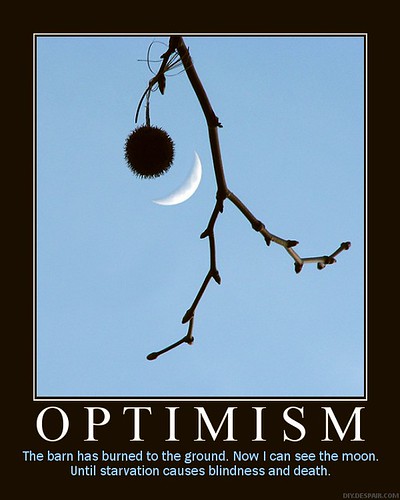
Optimism

This is, as you can see, addictive. Last one for today, I promise. And btw they are supposed to be funny, not a subtle statement about incipient suicide. I think I’m usually rather blatant when I feel crap.

optimism

Click through for a bit more info about who said it first (minus the starvation of course).

Update Oh frabjousity! there’s a de-motivator flickr group.

Life

life

Yes, another one. Couldn’t resist adding life to hope.

Update Can’t understand why the picture’s not showing up on the blog when it’s large as, er, life on the preview. For anyone intensely curious about the meaning of life who can’t see the answer, try clicking here.

Despair and demotivation

The seriously laugh-out-loud funny sight despair.com has, amongst its pages of satirical goodness, what it calls a “Parody Motivator Generator“. Choose a picture from amongst your favourite affirming images to upload, add your title and text, fiddle with the colours and total dissatisfaction can, and often does, ensue.

hope

Go to their gallery of delightful demotivational products for some disinspiration. I particularly enjoy despair, dysfunction and loneliness. And don’t forget to check out who the manufacturers suggest each poster is particularly suited to. Most impressive in this regard is consulting with its clever alternating urls for the first link (must find out how that’s done). And whatever you do don’t click that second link. No, don’t. Really.

My poster is another version of the phrase used in their adversity poster. The original Nietzschean nonsense has always annoyed me.

Picking

Now the sun is out the white marks show up more clearly against the tanning skin, a landscape of negative freckles.

I’ve been reading about the psychology of relationships a lot recently because of the dawning realisation that I don’t know how they work. Just as one acquires language as a child so one acquires social, interpersonal and emotional skills. Unfortunately if the available vocabulary of the latter is severely limited then the subsequent ability to communicate in these ways is concomitantly crap.

Research, observation and modelling the behaviour of others helped me immeasurably in the mission to acquire parenting skills which are, after all, a very specific set of relationship abilities. I’m still crap at it, but, thank god, it’s clear that I’m not as crap as my mother was. Mainly I suppose because I’m not as ill as she was. My travels through wikipedia in search of insight brought me to attachment theory, from there to reactive attachment disorder and complex post traumatic stress disorder.

Such a lot of long labels and phrases. Words, words, words. And yet. And yet. It’s deeply, viscerally shocking and upsetting. To be taken back to the obsessive gouging of flesh, pulling at the layer beneath the skin, tearing away as the white vacancy fills with bright red sting and tang of blood. The sight and the smell and the taste (sucking the blood, sucking the blood hard to pull out the venom of badness, one day, one day if I do this enough maybe it will be gone, the invisible stigma, the evil that must lurk, must be exorcised, excised, and then look at the white bloodless flesh and the red seeping in again).

I used to do this every day.

Sometimes I still do.

Apparently a characteristic symptom is “belief that one has been permanently damaged by the trauma”. How can this be merely a belief when the evidence is there, carved indelibly across the surface of my being in marks of tan and white.

Torso

torso

Or should it be trunk? when actually it’s a root. Oh well, you get the general idea.

Most of the Suffok pictures are now up, I think, and can be seen in a slideshow.

The most viewed, apart from the pipefish, is one of the secondborn’s lower extremities which seems to be very popular among the community which finds such body parts particularly exciting. Some of whom have accounts seemingly without their own pictures but lots and lots of other people’s saved for future reference. I’m not really sure how I feel about this.

If only Maizy was a bloodhound

The firstborn has a mobile. It is sleekly curved, slightly rubberised to the touch, a pleasing matt black. It is called a pebl. That’s pronounced “pebble”. Firstborn flips it open with a neat flick of a single hand which is considered extremely cool by his peers. According to the manufacturer:

With chic simplicity, the subtly stylish Motorola PEBL adds a calming convenience to your everyday travels.

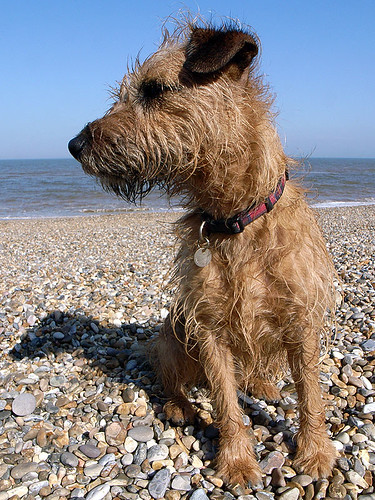
Really? Calming? We are currently on our travels, camping on the top of a cliff overlooking this beach (also a gratuitous Maizy picture but I can’t resist).

her supreme saltiness of sea dog

You will note that it is shingly. Stoney. It is, in fact, entirely covered in pebbles. They are its most obvious feature. Can you guess what’s next?

Yes. Firstborn managed to lose his pebl on the beach.

We narrowed down the area of potential loss to a quarter mile or so between a notice about crumbling cliffs and a lump of concrete which had crumbled down to the beach. Firstborn was extremely grumpy about being forced to go to the beach and the last time he had seen his phone was apparently when he made a call to moan about how miserable his life was and this call was by the yellow sign.

grumpy

Part of the outward and visible signs of extreme grumpiness are the headphones indicating that the grumpee is listening to music at an extremely high volume. It is, I conclude, an electronically-aided version of putting your fingers in your ears and shouting “la la la la la”, but I have decided not to mention this to the grumpee in question.

It would be an exaggeration to say that we subjected the place to a finger-tip search but we certainly spent more than an hour scanning the area, first side to side in strips parallel to the sea then, when that revealed nothing, in strips up and down between sea and cliff. At intervals I rang the phone hoping that we would hear it over the crash of the waves until its owner remembered that it was set on vibrate.

The organisation of the beach was fascinating. At the base of the cliff tiny pebbles which gave way to succeeding banks of shingle organised by size of stone. The most difficult to scan were those banks where the pebbles were the same size as the phone. What we really needed was a bloodhound, suggested secondborn, because Maizy was no help at all and when told to “seek” ran up the side of the cliff like a mountain goat and disappeared over the top.

The sun lowered in the sky. The shadows cast by the cliff were deep and dark. The chill was enough to make us, t-shirted as we were, shiver. Secondborn sat on the stones and screamed about how miserable his life was.

When the shadows reached the sea I called off the search. Secondborn and I set off along the beach, Maizy trotting at our heels. Firstborn appeared to be labouring under a powerful and private emotion and we let him mourn alone.

When we were halfway across the stretch of beach between the yellow sign and the steps up to the campsite, the stretch of beach we had not searched, there was the phone, clearly visible, lying on top of the small stones in an entirely un-pebble-like manner.

Another search which concluded successfully was that of the identity of secondborn’s monster of the deep.

creature of the deep

Click through to the picture on flickr to discover the amazing resource that is the ID Please group. Many thanks to Dem for suggesting it.