10.5 ways of looking at a story (Africa and the Telling of Tales)

A village Chief listens during a community meeting / Ngegebma, Kailahun District
Community meetings are held in Kailahun’s villages to ensure the returnees successfully re-integrate. Here, the Chief of the village of Ngegebma listens to returnees’ questions.
Photograph by Caroline Thomas
Caroline Thomas is a documentary photographer based in Sierra Leone. She is a stringer for EPA and works with NGOs and the UN as a photographer and communications adviser.

The name Kailahun rang in my ears for more than a decade – the civil war in Sierra Leone was almost exactly coterminous with my time working for the BBC Africa Service – but I’ve never seen the place. I find this picture, from the new website African Lens (Telling the Story of Africa), both beautiful and moving.

The inaugural editorial is suitably thought-provoking and concludes on a rising clarion note:

These are exciting times for visual storytellers, with the power of the web facilitating the global production and circulation of new photographic projects. There are many challenges involved in getting better stories to the right people, but the gatekeepers of the mainstream media no longer have total control over what we can or cannot see. If we appreciate how stereotypes have been produced and can be contested, we can, over time, achieve the re-visualization of ‘Africa’.

The author, academic David Campbell, links, more than once, to this utterly delightful TED talk by Chimamanda Ngozi Adichie which I’m embedding here in the hope that everyone who comes across it will watch it all the way through. It’s worth every minute of it.

A vision indeed. But perhaps if every child in the world were issued with and inspired by Ben Okri’s 10 1/2 Inclinations (advice he formulated when asked to recommend the top ten books he thought children should read) we should be nearer that three-dimensionality of mind:

The 10 1/2 Inclinations

1.) There is a secret trail of books meant to inspire and enlighten you. Find that trail.
2.) Read outside your own nation, colour, class, gender.
3.) Read the books your parents hate.
4.) Read the books your parents love.
5.) Have one or two authors that are important, that speak to you; and make their works your secret passion.
6.) Read widely, for fun, stimulation, escape.
7.) Don’t read what everyone else is reading. Check them out later, cautiously.
8.) Read what you’re not supposed to read.
9.) Read for your own liberation and mental freedom.
10.) Books are like mirrors. Don’t just read the words. Go into the mirror. That is where the real secrets are. Inside. Behind. That’s where the gods dream, where our realities are born.
10.5) Read the world. It is the most mysterious book of all.

(Okri via Jeremy.)

Five point five

I’ve knitted five point five pairs of socks so far this year. (And blogged here once. So infrequently that every time I open up the dashboard I’m told I need to update the software which takes time and destroys motivation.)

Of those 11 socks four were for B2 whose feet grow at the usual implausibly fast rate of the young and who will only wear socks which have not been knitted by me under protest. So he’s had two pairs in basic rib to replace the two pairs he’s grown out of.

The odd sock was the second half of a pair for my father started long ago. They’re from the wonderful New Zealand based website Vintage Purls which hosts a selection of free vintage patterns. These are “Golf Hose in Cable Stitch” from a pattern published in 1935 and they fit superbly. They’re on ravelry here. They, and the chance discovery of a useful row-counting method, featured in an earlier (two years earlier… that’s serious second sock syndrome!) post.

socks 2

The other three pairs have all been for me, two of them the product of fabulous gifts of yarn. The first some Noro Silk Garden Sock from P. Much thought was devoted to which pattern to use, the end result (Seven of Hearts by Omly Crafts) being a reference to these. Much effort was expended to ensure that, making two socks from a single ball of yarn, not a single inch of the was wasted and that the stripes on the socks matched up as far as possible. This involved kitchen balance scales, frequent restarting of the toe of the second sock and using some of the yarn from the first sock to finish the top of the second sock. The result, however, is pleasing even to this verging-on-obsessive perfectionist. [On ravelry.]

hearts2

The second birthday socks, yarn from A, required less cogitation and no scales. Firstly because Koigu Painter’s Palette Premium Merino (also known as KPPPM) comes in 50g skeins, each enough for a single sock, secondly because it was immediately obvious this was the yarn I’d been waiting for to use for Cookie A’s Pomatomus which I’d been wanting to knit for a long time. The only faffing incurred was converting the pattern to be worked from the toe up, thus allowing the socks to be as long as possible and all the yarn to be used. The modifications are on ravelry.

hippo1

On, on. Sock knitting – portable self-soothing. Next up are various short lacy plans in non-wool yarns for summer. There’s even a thought for a design of my own fermenting gently in the back of the brain.

Knitting on sticks

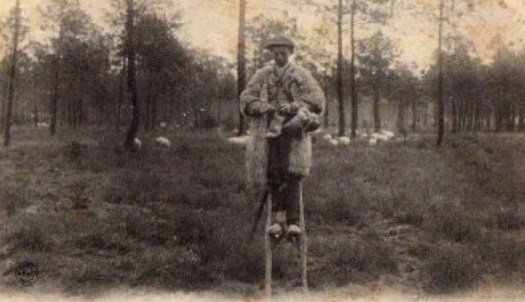
Shepherd on stilts, knitting, with his flock 1905

Stilts first appeared well before the forest, when Les Landes was an immense marshy country, very flat, with the vegetation primarily consisting of grass and undergrowth. Principally, it was shepherds who lived in this landscape. The shepherds had several reasons for using stilts:

  • in order to more easily make a path through the vegetation when the shepherds travelled the long daily distances required by their sheep-tending;
  • to avoid wetting their feet in the marshes;
  • but their main use was to be able to supervise their flocks of sheep from afar.

The medieval peasants of the marshy Les Landes area kept vast herds of sheep. The shepherds used the sheep for manure and wool, rather than meat. It is said that these shepherds would walk on stilts to increase their stride and see greater distances, and knit while watching their sheep. To keep their wool from ruin, these men wore a knitting belt and made their own felted jackets and protective clothing for their feet.

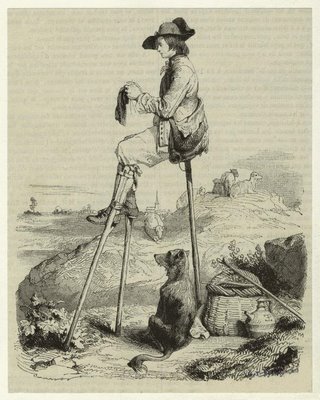
The great, home-hewn ash poles were kept on hooks attached to the beams of cottage ceilings and could be mounted with ease by sitting on the mantelpiece, or with more difficulty from ground level. The walker lashed the stilts to his upper legs by cloth or leather bindings called arroumères, and thus left his hands free. He carried a third and longer pole as a balance, and when stationary he could prop his back on it to provide a firm tripod while he watched over the sheep. On his back he carried a little satchel, the baluchon, in which he kept food, animal medicines and the materials needed for knitting the footless stockings peculiar to the district.

Shepherd resting on stilts and knitting

There are tantalising suggestions that the shepherds used hooked needles (whether latched or not I can’t make out) but I don’t have access to either the book or the paper in which this appears to be recorded.

People who saw them in the distance compared them to tiny steeples and giant spiders. They could cover up to 75 miles a day at 8mph. When Napoleon’s empress Marie-Louise travelled through the Landes . . . her carriage was escorted for several miles by shepherds on stilts who could easily have overtaken the horses.

Claret and Olives, Angus Bethune Reach, 1852, pp 72-74:

The novelty of a population upon stilts men, women, and children, spurning the ground, and living habitually four or five feet higher than the rest of mankind irresistibly takes the imagination, and I leant anxiously from the carriage to catch the first glimpse of a Landean in his native style. I looked long in vain. We passed hut after hut, but they seemed deserted, except that the lean swine burrowing round the turf walls gave evidence that the pork had proprietors somewhere. At last I was gratified ; as the train passed not very quickly along a jungle of bushes and coppice-wood, a black, shaggy figure rose above it, as if he were standing upon the ends of the twigs. The effect was quite eldritch. We saw him but as a vision, but the high conical hat with broad brims, like Mother Bed-cap’s, the swarthy, bearded face, and the rough, dirty sheep- skin, which hung fleecily from the shoulders of the apparition, haunted me. He was come and gone, and that was all. Presently, however, the natives began to heave in sight in sufficient profusion. There were three gigantic-looking figures stalking together across an expanse of dusky heath. I thought them men, and rather tall ones ; but my companions, more accustomed to the sight, said they were boys on comparatively short stilts, herding the sheep, which were scattered like little greyish stones all over the waste.

Anon, near a cottage, we saw a woman, in dark, coarse clothes, with shortish petticoats, sauntering almost four feet from the ground, and next beheld at a distance, and on the summit of a sand-ridge, relieved against the sky, three figures, each leaning back, and supported, as it seemed, not only by two daddy long-legs’ limbs, but by a third, which appeared to grow out of the small of their backs. The phenomenon was promptly explained by my bloused cicerone, who seemed to feel especial pleasure at my interest in the matter. The third leg was a pole or staff the people carry, with a new moon-shaped crutch at the top, which, applied to the back, serves as a capital prop. With his legs spread out, and his back- stay firmly pitched, the shepherd of the Landes feels as much at home as you would in the easiest of easy chairs.

” He will remain so for hours, without stirring, and without being wearied,” said my fellow-passenger. “It is away of sitting down in the Landes. Why, a shepherd, could stand so, long enough to knit a pair of stockings, ay, and not have an ache in his back. Sometimes they play cards, so, without once coming off their stilts.”

The best project ever (so far)

It started with a mail via flickr, one of those “you don’t know me, but… ” that usually mean something interesting is about to happen. It was headlined “Soon to be Doctor Krista“:

I’m Krista’s Dad and I need a favor from you – I need to find a Doctor Who scarf. Of course it needs to come from the Mother Country, not some colonial fake. Where can I buy one or could you make her one? I tried to find her a Tardis and did not have any luck so I thought of the scarf. For one of my birthdays she and her mother gave me a commemorative Dr. Who stamp so now with her becoming a true doctor, I must repay in kind.

How many levels of awesome is that? For a start there’s Krista’s geektasticness for even knowing, let alone loving, Dr Who, a British sci-fi tv series born several decades before she was as well as the other side of the atlantic. But even more awesome as far as I’m concerned is the fabulousness of her parents who knew of and appreciated her interest and came up with possibly the best PhD present idea in the world. (I think they must have known I knitted because of this.)

And it only got better. Because there is (but of course) an entire website devoted to this singular (and yet, as we shall see, multiple) item of clothing – The Doctor Who Scarf. Which is not one scarf but a multitude of different scarves which mutated over time (but not always linearly to the the viewer) and even regenerated into something, visually at least, very different.

A piece of swift and unscientific research revealed that, to us Brits, the original is also the best, so that’s the scarf that was made since we couldn’t find one for sale. Armed with a printout of the “pattern” I went with artist F, who has, unsurprisingly, superb colour sense, to the nearest large haberdashery department to get the wool. This looked as though it might be a considerable challenge since all the brands featured on the website are American and not widely available here (if at all). But we were fantastically lucky. The Rowan yarn Wool Cotton has a very close approximation to each of the seven shades required and is, miraculously, also the right weight.

1 The yarn

Knitting started in the summer on Holy Island, and continued hither and yon through the autumn. This thing is BIG. There was a hideous number of ends to darn in and tassels to be added. Finally it was finished, ceremonially photographed

9 Ok, so I broke the gate

and despatched.

At last, months after Krista was Doctored and even more months after it was started, it has found its home. Hurrah!

(It’s on ravelry here.)

TP still All Powerful (unlike me who failed to click "publish")

Being in the presence of the music of the Tout Puissant Orchestre Poly-Rythmo de Cotonou is like… well it’s like being massaged by one of those road-mending whumpy things (albeit with a padded thumpy bit) at an above heartbeat rate of mind-bending rhythmic complexity operated by James Brown on ayahuasca. In a really fantastically good way.

the band

That’s still true today (or, more accurately, last night [now more than a month ago, but hey, who’s counting]) more than 40 years after the band was founded. Perhaps the energy had something to do with the fact that the date was particularly auspicious being the 64th birthday of founding member Clement Melome (Benin’s current average life expectancy at birth: 59 years). They may be pensioners – from the great distance of the Barbican balcony Clement Melome’s rotund figure and large white cap made him look like a middle-aged woman on a shopping trip – but by the gods they can still FUNK.

And by the gods it is (although more accurately Deity helpers or Orishas) – the music has its roots in the Vodun religion, as explained on the Analog Africa record label website:

The cultural and spiritual riches of traditional Beninese music had an immense impact on the sound of Benin’s modern music. Benin is the birthplace of Vodun (also Vodoun, or, as it is known in the West, Voodoo), a religion which involves the worship of some 250 sacred divinities. The rituals used to pay tributes to those divinities are always backed by music. The majority of the complex poly-rhythms of the Vodun are still more or less secret and difficult to decipher, even for an accomplished musician. Anthropologists and ethnomusicologists agree that this religion constitutes the principal “cultural bridge” between Africa and all its Diasporas of the New World and in a reflection of the power and influence of these sounds many of the complex rhythms were to have a profound impact on the other side of the Atlantic on rhythms as popular as Blues, Jazz, Cuban and Brazilian music.

Two Vodun rhythms dominate the music of Orchestre Poly-Rythmo: Sato, an amazing, energetic rhythm performed using an immense vertical drum, and Sakpata, a rhythm dedicated to the divinity who protects people from smallpox.

So there’s this astonishing mix. There are rhythms the like of which are not heard anywhere else. Then there’s the funk of James Brown:

According to their sax player Pierre Loko, who I met this month in Paris, while the word funk came from America, the rhythms are from Africa, and particularly Benin “We had a style called additivo which was very similar – and then we heard James Brown and thought he was doing African music”. What they did learn form Brown, he says, “was his energy, his showmanship, his style”. What actually resulted was a two- way conversation, with James Brown’s band visiting Africa “we learned from each other”.

This conversational style they call voodoo funk. And why not. But there’s a third interlocutor – Brazil:

Ironically, few of the musicians that have graced the Orchestre Poly Rythmo since it began in 1966 are professionally trained. They draw inspiration from a heritage that is rooted on Benin’s Atlantic Coast, where the Agoudas live. This ethno-linguistic group are descendants of former Brazilian slaves who returned to West Africa at the end of the 19th century, bringing back protosamba songs and dances that impregnated the local traditions.

The Orchestre has been able to mix this heritage with a fascination for African American funk, Latin grooves and the home-grown rhythms that punctuate voodoo ceremonies. Most of their 500 songs were recorded live with a couple of microphones and a Swiss-made Nagra reel-to-reel tape machine. The studio was a living room in the noisy neighbourhood near Cotonou’s airport.

Despite being massive in Benin, huge across West Africa, things were not always easy even when the band took the politically expedient route so many did, as singer Vincent Ahehehinnou told Independent journalist Nick Hasted:

“After the revolution [when Mathieu Kerekou’s regime, installed in 1972, began totalitarian, Marxist-Leninist inspired oppression in 1975], we were not allowed to play after 11pm on weekdays. And when the people came out of the venue, the police were waiting for them. If they picked you up outside a nightclub, they would say you were imperialist and anti-revolutionary! People were forbidden to hang out in the dark. They were disappointed and desperate, and didn’t even want to step out of their house any more. We feel bitter.”

Typically for Africa then, Poly- Rythmo were made the national orchestra by the new regime, and played its patriotic songs daily at the presidential palace. But even on a state-sponsored trip to Libya, trouble found them. “At the Libyan airport, the organiser said because we were musicians we were drug addicts. They took us to the third floor of the airport to check everything. Then they threw our instruments through the windows. And the government didn’t replace them. So it became harder and harder to play.”

So the gig. Well, it was great. So they’re old men. So they shuffle rather than shimmy. So what? The music’s still great. All those words – driving, pulsing, psychadelic – they’re still applicable.

There’s a wonderful story behind this the band’s first European tour.

part 2

The Kings of Benin Urban Groove 1972-80 which is apparently being reissued this week [now, err, last month] and there’s another compilation “Echos Hypnotiques – From the vaults of Albarika Store, 1969-1979 (Volume two)” out on 26 October [now also last month] on Analog Africa.

Trafigura and the Great Firewall of Westminster

Update (13/10/09 1330): The gag has been lifted.

London’s Guardian newspaper has been gagged from reporting a specific item of parliamentary business. The subject of the gagging order is thought to be a question to be asked by an elected MP of the Secretary of State for Justice:

Paul Farrelly (Newcastle-under-Lyme) – To ask the Secretary of State for Justice, what assessment he has made of the effectiveness of legislation to protect (a) whistleblowers and (b) press freedom following the injunctions obtained in the High Court by (i) Barclays and Freshfields solicitors on 19 March 2009 on the publication of internal Barclays reports documenting alleged tax avoidance schemes and (ii) Trafigura and Carter-Ruck solicitors on 11 September 2009 on the publication of the Minton report on the alleged dumping of toxic waste in the Ivory Coast, commissioned by Trafigura.

All that the Guardian can say about it is here.

The question has been written down and noted in the public record of parliamentary business and is timetabled to be “asked” in the House of Commons later this week.

The UK libel laws are byzantine and tightly drawn but one clear and simple certainty has been in place for nearly 40 years: “fair and accurate” and timely reporting of procedures in parliament are subject to absolute privilege, the highest protection against legal action possible.

This action is an entirely cynical attempt to cover up an appalling scandal involving a rich, powerful, politically well-connected and enthusiastically litigious corporation on the one hand and tens of thousands of sick poor people and major environmental damage on the other.

It’s not much of a surprise that Trafigura would attempt to prevent publication of evidence of their wrongdoing, evidence which might also show that the proof of their wrongdoing has been known to them for the last three years. For the past three years the company’s lawyers have been busy filing action after action against media organisations both here and in other European countries where legal action is being taken on behalf of Ivorian victims of the toxic dumping.

What is particularly worrying and anger-inducing about this business is that an English court granted the request for the gagging order.

Now here’s a bit of background about the information Trafigura and the company’s legal representatives do not wish to gain publicity. Cos, you know, gagging newspapers in the teeth of decades of established case law is the sort of action which invites such a public airing.

The parliamentary question concerns the oil, metals and minerals trading company Trafigura (which has close ties to the opposition Conservative party) and an inquiry into allegations that the company dumped toxic waste along the offshore waters of the Ivory Coast which then washed ashore on land in Ivory Coast capital Abidjan and affected the health of tens of thousands of Ivorians. The original story was carried in the Guardian on 14 May 2009:

Documents have emerged which detail for the first time the potentially lethal nature of toxic waste dumped by British-based oil traders in one of west Africa’s poorest countries.

More than 30,000 people from Ivory Coast claim they were affected by the ­poisonous cocktail and are currently bringing Britain’s biggest-ever group lawsuit against the company, Trafigura.

The firm chartered the ship, Probo Koala, which transported the cargo to Ivory Coast in 2006.

An official Dutch analysis of samples of the waste carried by the Probo Koala indicate that it contained approximately 2 tonnes of hydrogen sulphide, a killer gas with a characteristic smell of rotten eggs.

The documents have been obtained by the BBC. One chemist told BBC Newsnight last night that if the same quantity and mixture of chemicals had been dumped in Trafalgar Square: “You would have people being sick for several miles around … millions of people.”

Trafigura, which claims to be one of the world’s biggest independent oil ­traders, originally issued statements in 2006 denying the tanker was carrying toxic waste. It said it merely contained routine “slops” – the dirty water from tank washing. Executives of the company lined up to specifically deny that the waste contained any hydrogen sulphide.

However by mid September Trafigura suddenly announced it had reached a settlement for the 30,000+ claims of compensation in the wake of the dumping.

The fuss now appears to centre around a report by science consultancy Minton, Trehane & Davies into Trafigura’s toxic waste disposal practices. It was commissioned by commercial and shipping law specialists Waterson Hicks and there is a pdf copy (downloadable from the wikileaks entry above) dated 14 September 2006.

Should the conclusions as outlined in the pdf bear any resemblance to the content of the report then Trafigura have been copped, bang to rights, and, what is more, they’ve known about the evidence of their wrong-doing for the past three years.

Tut tut tut. Naughty Trafigura.

On the bus

men waiting for work

The bus paused for the lights at the large intersection next to the wall where, every day, men congregate in garrulous groups waiting for work. Sometimes I pass when a van draws up, rapid negotiations are transacted and one or more clamber into the back and the van drives off.

Mostly the men stand with their fists pushed hard in their pockets but today I noticed one who was systematically burning the hairs on the back of his hands with his cigarette, between drags. Even from the height of the top of the bus I could see the skin was covered with shiny white sequins of old burn scars.

man with bare feet

I’d scoffed most of a packet of biscuits (it’s a long journey) before realising that while not illegal it might have been inconsiderate.

man with scar

The light on the scar on his knee – that was what I was interested in. But unfortunately the camera wasn’t.