Mahabharottontomato

This” said my friend as the lights went up for the interval, “is torture“.

It was such a shame. It promised to be a great theatrical event – five years in the making with contributions from an award-winning composer, lyricist and choreographer and including puppetry and video projection. Unfortunately it was a complete mess.

The lyrics were perhaps the worst part of this anti-gestalt entity. Banal nigh unto nausea with the plodding rhymes of greeting card doggerel. These lyrics had been set to (or had composed for them) almost equally tedious music. They were then sung by vocalists of such mediocre-to-non-existent talent that ones ears curled in an effort to block out the noise. Particularly disappointing since I’m a great fan of Nitin Sawhney.

The dancing, apparently a whole “new vocabulary”, failed to communicate anything very much. The battle scene in particular, allegedly the war to end all wars, the ushering in of a new dark age, resembled a small-scale difference between drunken morris dancers holding garden canes.

Both the video projections and the puppetry were badly-executed tokenistic add-ons which merely served to highlight rather than cover the gaping cracks.

The god Krishna was on stage for most of the performance. Sadly for one supposed to be the powerful all-attractive deity, prince, warrior and philosopher, he was a decidedly uncommanding presence being small and dumpy, and sported something which looked disturbingly like a vestigial chest-wig but might have been some form of necklace. We, in our top-price seats, were too far away to tell.

Also hugely disappointing was the compacting of the Bhagavad Gita into a couple of minutes of stilted and bizarre dialogue between Krishna and Arjuna which appeared, in summary, to be “it’s ok to kill people because they have another life anyway”. However the quotation made famous in the west by Robert Oppenheimer, “Now I am become Death, the destroyer of worlds” was put in the mouth of Draupadi, the heroine from whose point of view the story had been reworked.

It wasn’t entirely dreadful. When anyone sang in a language other than English both the delivery and scoring was noticeably superior. The “pas de deux” between Draupadi and Arjuna was well done, set to a track from one of Nitin Sawhney’s albums. The set, a Frank Gehry-esque metallic-looking sweeping curve of a rampart, was wonderful but ill-used.

However the evening would best be summed up by the lyrics droned repeatedly by Draupadi in a sub-Lloyd-Webber fashion: “when will it end?“.

Answer: not soon enough.

Loathing manacles

The Invitation

It doesn’t interest me what you do for a living.
I want to know what you ache for
and if you dare to dream of meeting your heart’s longing.

It doesn’t interest me how old you are.
I want to know if you will risk looking like a fool
for love
for your dream
for the adventure of being alive.

It doesn’t interest me what planets are squaring your moon…
I want to know if you have touched the centre of your own sorrow
if you have been opened by life’s betrayals
or have become shrivelled and closed
from fear of further pain.

I want to know if you can sit with pain
mine or your own
without moving to hide it
or fade it
or fix it.

I want to know if you can be with joy
mine or your own
if you can dance with wildness
and let the ecstasy fill you to the tips of your fingers and toes
without cautioning us
to be careful
to be realistic
to remember the limitations of being human.

It doesn’t interest me if the story you are telling me
is true.
I want to know if you can
disappoint another
to be true to yourself.
If you can bear the accusation of betrayal
and not betray your own soul.
If you can be faithless
and therefore trustworthy.

I want to know if you can see Beauty
even when it is not pretty
every day.
And if you can source your own life
from its presence.

I want to know if you can live with failure
yours and mine
and still stand at the edge of the lake
and shout to the silver of the full moon,
“Yes.”

It doesn’t interest me
to know where you live or how much money you have.
I want to know if you can get up
after the night of grief and despair
weary and bruised to the bone
and do what needs to be done
to feed the children.

It doesn’t interest me who you know
or how you came to be here.
I want to know if you will stand
in the centre of the fire
with me
and not shrink back.

It doesn’t interest me where or what or with whom
you have studied.
I want to know what sustains you
from the inside
when all else falls away.

I want to know if you can be alone
with yourself
and if you truly like the company you keep
in the empty moments.

Oriah Mountain Dreamer

Via Erzsebel‘s Clock

Continue reading “Loathing manacles”

Winter holiday

The trick, I find, with hot lemon, honey and whiskey, is to add the whiskey last after the mixture has cooled a little in order not to drive off too much of the alcohol. It being lunchtime I have, after long and deep reflection, decided to defer the whiskey until the bedtime brew. I can tell that it’s a vital ingredient by the way the whiskeyless blend slips down with only minimal stinging. The alcohol is essential for efficient scrubbing of bacteria from the throat.

The sweet-sour medicine is in my new mug, a present from Small-Loch A, which is decorated with a reproduction of the original cover of Winter Holiday by Arthur Ransome. It’s profoundly comforting. As a child, and well into my teens, I was regularly woken by nightmares of great terror which would recur as soon as I went back to sleep. The antidote, a result of some historical accident no doubt, was Winter Holiday which took up permanent residence beside my bed. I read and re-read and read again, probably hundreds of times over the years, as much as was required to result in eventually falling into a dreamless sleep.

Maizy too has been unwell. On Tuesday morning she suddenly started shivering violently and slunk under the kitchen table with her tail as far between her legs as such a docked appendage can reach. Nothing would coax her out. When I crawled under the table towards her she slunk out, her paws leaving little wet prints on the wooden floor. She screamed when I tried to pick her up.

The vet explained that the wet paw-prints were the result of sweating caused by stress. She also said, after a thorough examination, that she thought Maizy had pulled or sprained a muscle around her right back leg. I have little doubt this occurred during one of Maizy’s regular attempts to scale the 5-foot high wall into the neighbour’s garden in pursuit of next-door’s cat. The vet’s kind words and a pain-killing injection left Maizy (temporarily) slightly sprightlier and my wallet £52 lighter. Only today (Friday) did Maizy managed to climb up the two stairs on the ground floor of the house without standing in front of them and howling for help first so either it was quite a serious pull/sprain or she’s a total big girl’s blouse.

It’s the first time Maizy’s been seriously out of commission and the peace and quiet has been deeply disturbing. Although also having the benefits of, well, peacefulness and quietude. Even the cat has shown signs of distress, bouncing and pouncing, batting her with his claws and biting her neck in an effort to get her to play. But all to no avail: Maizy remained supine, curled motionless on her bed. Lying doggo.

She’s not the only one who’s had her head under a blanket recently. I’ve been in deep denial about how ill-equipped I have been to do my duties at Global Voices. But the sad truth is that I don’t have what it takes to do the job properly. Too big, too amorphous, too stressful, too unstructured, too isolated for my currently compromised capabilities. It’s extremely sad for me. I think what GV does is brilliant and much needed work. I have made really important and enduring friendships and met a huge range of wonderful and notable people, and I am and will remain extremely grateful for the entire experience.

I now have a few weeks transition into a world where a vet’s bill of £52 takes on an altogether deeper significance than heretofore. I enquired about work at the local bookshop the other day. The manager remembered me from the occasion when I interviewed her for a piece I was doing when arts correspondent. The pay, assuming they have a vacancy, which they don’t, is £5.50 per hour.

Now many things can be measured in pre-tax bookshop hours (ptbhs). Maizy to the vet? ten ptbhs. Fill the van with petrol? Seven ptbhs. One cup of coffee, one hot-cross bun and two loaves of (admittedly rather exotic) bread – 2 ptbhs. A frugal week’s food shopping – 15 ptbhs. One hour of babysitting? 1.75 ptbhs. And so it goes, untenably, on.

It’s an interesting problem, that of generating enough money to keep body and sons together (and house and pets and van). But also to be able to do their homework with them, cook them interesting food, tuck them into bed. Small goals. A tiny horizon. More time, less stress. A little life.

Roses, sugar and pomegranates

“Are you happy with your choice?” he asked as I straightened up from taking a picture of the serried ranks of roses.

A country accent, bright blue eyes, collar length white hair thinning on top and shabby clothes. He had a petite and exquisitely turned-out woman clinging to his arm. Black high heels, flawless makeup, long black coat. His question seemed serious.

roses are red

“Well, I like the picture but I don’t like the roses” I replied, after a pause for thought.

“Why not?”

“Well, they look far too artificial. Too many petals crushed into too small a space. They look forced, as though they can’t breathe. They’re a bad shape. And the colour,” I added, warming to my theme, “there’s too much dark blue and purple in it. They look bruised. Battered. Attempting perfection and failing.

“I’m sorry…” suddenly catching a glance of the expression on the woman’s face, “these are just my opinions and I’m sure many people feel differently about them.”

“No, I’m interested”, he replied, folding, unfolding and refolding a small piece of paper in his hands, a receipt perhaps.

“But daddy!” the woman exclaimed in a voice which carried not the trace of an accent but betrayed her youth. I realised with a shock that she was in her very early teens.

“There are lots of other roses”, she said. “What about those?” She gestured to a bunch of buds in a sepulchral shade of near black.

“What do you think of them?” he asked.

“Too gloomy. They look like they’ve come off the set of a gothic film.”

His daughter had let go of his arm, presumably exasperated by the sudden complication of what I assumed was supposed to be the purchase of a valentine’s gift for her mother.

“What I’m worried about his how much they’re going to set me back” he said, rather grimly, as he again mechanically folded and unfolded the piece of paper.

“Well, this is Liberty, so whatever you buy will probably be the best of its kind”, I offered as the only consolation against excessive outlay I could think of.

“As well as the most expensive”, I thought as I shook his hand and left them examining the display, relieved he hadn’t asked me what I would choose.

sugar is sweet

Outside the tube station an altogether different approach to the rose trope. What would I choose here? The red-pawed cream bear holding a bunch of artificial roses? the rose-patterned-cellophane wrapped pink fluffy heart with “I love you” stitched in curlicues of scarlet? Or the string of flashing fairy lights twined with a creeper of blowsy rose-red plastic-petalled blooms?

As difficult a decision and no doubt involving products with a similar hefty mark-up albeit starting from a lower base price. Choices, choices.

Tomorrow, valentine’s day, I go to a mediation meeting to discuss the Solomonic topic of splitting the children. Not to mention the property. I’m perhaps not best placed to appreciate the current proliferation of roses, whatever form they take.

and so are you

What I would choose, if I were asked, would be a bunch of pomegranates. Ripe with symbolism I should choose to think of the story of Persephone and the revolving of the seasons.

But I shouldn’t think about it too hard because there’s all sorts of mother-daughter shit which would do my head in. And besides I would be too busy fiddling around trying to eat the damn things. Have you ever tried getting all those hundreds of seeds out?

PS Don’t forget to enter the Global Voices Valentine’s Day Poetry Contest! Even a cynical old saddo such as I might have a go, probably the very best antidote available for rose-overdose.

I’ve found God AND mortality

Not bad for a weekday lunchtime.

mortal(ity) and God

On the left there we have Ivy Alvarez with mortal, on the right we have Natalie d’Arbeloff (in the guise of her alter ego Augustine) with The God Interviews. Both have very recently been delivered, after long labour, of a book. As you can see.
I shall endeavour to review both when I’ve read them in their entirety. So far I can say I thoroughly recommend both babies books.

Also I can say that I find it puzzling that the name Natalie d’Arbeloff isn’t as famous as that of Maira Kalman. The latter is a wonderful artist who’s clever with words. So is the former. The latter has book deals and a blog with monthly posts which is syndicated by the New York Times. The former, utterly mysteriously, does not.

Unfortunately the NYT has hidden Ms Kalman behind a subscription, but a couple of her posts can be viewed here. And here’s a picture from her December post which I rather liked.

Bach dress

Anyway. The point of this digression is to suggest that anyone who wishes to support an artist and writer of true talent, grit and determination can easily do so by offering her a lucrative book deal for the follow-up which is already in the pipeline. Or failing that (if you don’t happen to be a publisher) buy the first instalment!

I've found God AND mortality

Not bad for a weekday lunchtime.

mortal(ity) and God

On the left there we have Ivy Alvarez with mortal, on the right we have Natalie d’Arbeloff (in the guise of her alter ego Augustine) with The God Interviews. Both have very recently been delivered, after long labour, of a book. As you can see.
I shall endeavour to review both when I’ve read them in their entirety. So far I can say I thoroughly recommend both babies books.

Also I can say that I find it puzzling that the name Natalie d’Arbeloff isn’t as famous as that of Maira Kalman. The latter is a wonderful artist who’s clever with words. So is the former. The latter has book deals and a blog with monthly posts which is syndicated by the New York Times. The former, utterly mysteriously, does not.

Unfortunately the NYT has hidden Ms Kalman behind a subscription, but a couple of her posts can be viewed here. And here’s a picture from her December post which I rather liked.

Bach dress

Anyway. The point of this digression is to suggest that anyone who wishes to support an artist and writer of true talent, grit and determination can easily do so by offering her a lucrative book deal for the follow-up which is already in the pipeline. Or failing that (if you don’t happen to be a publisher) buy the first instalment!

Oh you pretty things

Look through my camera what do I see

A crack in the sky
A crack in the sky

and a hand reaching down to me

All the nightmares came today

And it looks as though they're here to stay
And it looks as though they’re here to stay

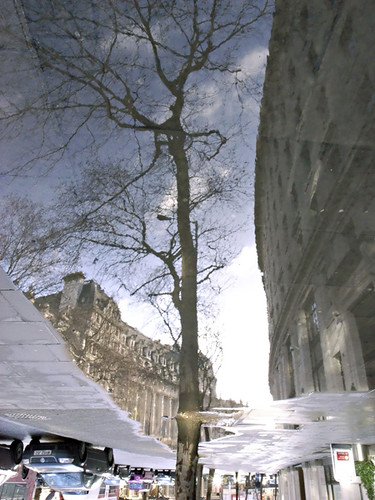
Heaven in water

heaven in water

I believd I could see heaven by looking into the water.

John Clare, quoted by Iain Sinclair in Edge of the Orison: In the Traces of John Clare’s “Journey Out of Essex”

I wrote my thesis on the bird poems of John Clare for no better reason than that John Clare was my brother’s favourite poet and after his death a year or so earlier I had inherited many of his books including John Clare: Bird Poems published by the Folio Society with illustrations by Thomas Bewick. Oh, and I also liked birds.

I ended up liking John Clare very much indeed too. He was mad of course.

Breaming

moon again

Flipping the meat off the bream with his knife he mused aloud about the journey.

“If you look on the map there’s nothing but trees. All green. And my time is limited. Damn and blast the traffic”.

This last imprecation was understandable in the circumstances. Due to fly to Libanda he had missed his plane by minutes. Many times before he had cut it fine, arriving late and clattering down, down, down the dark wooden escalators leading to the blue-lit check-in desks with his bag banging behind him. Such a slow and incongruously old-fashioned mode of moving, he always thought, as he gripped the worn hand-belt. More fit for an underground railway system than an airport.

Packing might also be to blame. Packing late, packing too much, unpacking and repacking obsessively. “Take it away” she had said. “All of it”.

There was so much of him had been left deliberately, and hopefully, in nooks and crannies, here and there, distributed between family and friends. Books, clothes, old photographs, boxes of music. Set down as remote roots, bonds. Nobody wanted them. Most had already been returned with varying degrees of civility. He picked carefully around the remaining caches, wondering how much to take, what to leave behind and whether another piece of the moss binding him to – what? security? a sense of belonging, somewhere, mattering, to someone? – would be prised from the mortar and fall to the ground. So much already lay withered, so few small patches remaining.

One result was the huge canvas bag which lay like an enormous brown dog at his feet. Much of his life lay inside it, organised into a complex hierarchy of transparent plastic bags of varying sizes. There was, he hoped, something for every eventuality and all arranged according to a complex law based on the probability of need and projected required speed of access.

It had been a change in this delicate equation which had meant he was late for the bus which was late for the train which was late for the second bus which disgorged him at the airport too late even for his practised breezy traveling persona to get him through to the departure gate.

There had been a story, in the news, of a woman whose life was saved by the insertion of a biro tube into her throat to act as an airway when she was in danger of choking to death. He had a biro but it was not among the emergency equipment. He kept a fibre-tipped pen to hand because it wasn’t prone to leaking and reacting badly to the rigours of changes in cabin pressure. But it had the wrong sort of tubing. Should he have a biro in his closest-to-hand-bag? and if so, with or without the slender column of unreliable ink?

“At least there was no hold-up with the visa” he said, pushing his now empty plate across the cloth towards her.

“They’ve got to know me there. Almost like visiting friends. ‘Strordinary place, the Libandan embassy. You ever been there?”

She shook her head.

“Huge town house. Not far from one of the palaces, you know, wide streets, big cars. Set back from the road. Completely empty of course. You have to knock and ring at the gate for an eternity before anyone comes. They don’t expect punters. Nobody wants to go there. When you do get in you’re escorted to a waiting room tricked out with a baby-blue leather three-piece suite and a massive marble-topped coffee table. Thick-pile cream carpet covered in dust and dead flies. Surreal.” He shook his head slightly.

“Must be an odd job. Set up in luxury by one corrupt dictator, serving out visas for visits to his killer. No money to send out someone new. No money to go home. That house must be worth millions. Chickens in the garden. I’m surprised none of the knobs in the other houses has complained. Maybe their walls are too high to see. Or maybe the chickens have diplomatic immunity!” He barked a rasping laugh.

“What are you going to do now?” she asked. This was approaching dangerous territory. She knew he had nowhere to stay, had given up his rented room; knew too that she had space to offer and wouldn’t; felt he knew this and resented his absence of reproach, her own gratitude for it. But she wanted to know.

Opening one of the many zips in the bag he extracted a map, wrestled and reconfigured its concertina folds and smoothed it across the table in front of them.

“See, this is where I was going to fly to”, jabbing the left edge of the exposed section. “Can’t get a refund on the ticket so I’m a bit short of the readies right now. There’s a boat over, but it lands up here”, jabbing a spot on what appeared to be a coastline near the bottom of the sheet. “But than what. There’s nothing there. Just all these bloody trees.” He rubbed the ball of his thumb moodily across the green print on the paper as though he could rub it away. And reveal what, she wondered, watching him. What was the contour and cartography of his heart’s desire.

“I must go now,” she said, getting up hastily and pulling on her coat. “Stay here – feel free” she added, gesturing with the flat of her hand as though ordering a dog to lie down when she saw him collect himself to rise. “It’s comfortable and warm. And get in touch when you know what your plans are.” She waved, a perfunctory window-wipe of a wave, turned hastily and walked quickly away.

He took her advice. His head laid to one side on the hard wood at the back of the chair, he gazed through the window out into the city sky growing darker and deeper as the winter light faded. The moon, a white semicircle, seemed embraced by the arms of the tree outside. He sighed. How often he had looked at it, bordered by so many different frames of circumstance and surrounding.

Sometimes, on the runway, in a small plane, the shuddering held-back force before takeoff felt like the tension of a huge catapult stretched to maximum tautness. Sometimes, eyes closed, the whoosh and hum of a large plane was the steeply curved launch of a ski jump. But that parting, the moment of peeling back space between earth and sky, never, he now knew, led anywhere other than here.

The moon remained as it had ever been. Cold, lifeless, utterly alone.

Out of kelter

I have pulled a muscle somewhere behind my right shoulder blade. Or it feels as though it’s behind… but really it’s difficult to tell because the sharp stabs of pain shoot forth with the undirected vigour of an exploding firework.

Throwing Maizy’s ball over-enthusiastically yesterday afternoon is probably the cause. It’s no doubt an utterly trivial sprain but the effect is highly annoying. Sleep last night proved very difficult. There are few positions I can put my right arm in which don’t cause at least some discomfort. The normal activities of living cause me to gasp with pain at entirely unpredictable moments in a manner I find both pathetic and irritating.

Canted to one side in a vain attempt to immobilise the offending area I’m no doubt making everything worse as the entire musculoskeletal system goes off balance. Damn damn damn.

But at least, thanks to ab, I’ve got to the bottom of kilter/kelter etymology – nothing to do with either kilts or helter-skelters, as can be seen below the fold should you be interested.

Continue reading “Out of kelter”