It’s such a pleasure to explore with someone from a different culture. Here am I, London dweller for 20 years who has never, in all that time, been to Highgate cemetery. It takes Neha and her new Nikon to get me over there.
In addition (or should it be subtraction) to never having visited I also know nothing about it apart from having a vague notion that Karl Marx is buried there. It is to Neha (who had of course thoroughly researched the topic) I owe the information that it was one of a number of burial grounds all constructed at the same time in different parts of London known as “the Magnificent Seven“. (Does this pre- or post-date the samurai and/or the subsequent cowboys? I can’t find out.)
In 1800 the population of London was 1 million.
By 1850 it had risen to 2.3 million. Such rapid population growth resulted in a lack of burial space. There were instances of body snatching, bodies left out to rot or not buried deep enough and bodies cleared from graves too soon…
From the 1820s onwards, private entrepreneurs solved the problem by creating suburban cemeteries, independent of the parish church, with ample, lovingly-landscaped acreage.
In an era before the existence of large urban parks, these garden cemeteries became popular places for a carriage ride or a stroll…
The Magnificent Seven appealed to the newly emerging middle class, keen to distance itself from the working class and to present to the public it’s social status.
Graves were seen as a public extension to the family’s property, and cemeteries provided a place for families to establish permanent monuments to themselves.
Death shall, of course, have no dominion over the class system. All it takes is a little time and vegetation. The environment was almost overpoweringly green – evergreen and lichen.

I particularly love the irony of carving into stone, presumably as an effort at an enduring memorial, an image of the very plant which shall pull it down.

Strolling round with a Hindu from India where death generally means consumption in fire, unmarked scattering of ashes in water and the resumption of life in another form gives added piquancy (or should that be spice?) to the more bombastic inscriptions celebrating warriors, diplomats, bravery, talent achievement and worth. Doughty survivors of “the Kabul campaign” and various actions in India drew particularly plosive harrumphs.
Words and symbols to shore up the living. For after all, with what eyes can the dead see? Although personality leaked out of many memorials, particularly those one assumes were designed or commissioned by the late lamented before they “fell asleep” or achieve the state of being (not being?) “at rest” (particularly popular Victorian euphemisms). Foremost of which was this marvellous stepped headstone.
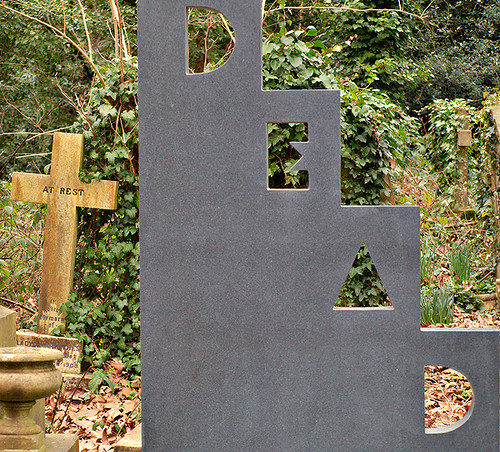
There is no trace of name/s or date/s on the large, pierced upright or the equally spacious matching horizontal slab. It might prove to be Dorothy Elisabeth Alice Davis who had a mordant sense of humour or an individual or group of people with equivalent graveyard wit but less of a coincidence to prompt it. It looks very new. I wonder whether more informative details than the current rather obvious statement will be provided later.
I knew of the Jewish custom of putting a pebble on a visited grave but it seems the tradition has morphed to include coins. Both have been placed on Douglas Adams‘s headstone but for that foremost critic of the capitalist system there can be no casting of stones, there can only be change…

…unless you count the stamp, first class, which someone had stuck on the side of the large and ugly monument.
There’s a lengthy discussion about putting coins on graves on one of the flickr groups devoted to cemeteries but it doesn’t give any really convincing particular origin for the habit. One interesting snippet, though, is that copper kills lichen. So Marx will never go green. Other, perhaps, than localised dribbles of cuprous salts.
Even Neha and I, who seem able to laugh at most things, find it difficult to be mirthful in the face of the death of children and this cemetery, like all others, has its share of infant mortality. How to deal with the grief of such a loss? how adequately to express or assuage the pain? Tastes have of course changed. Take this memorial sculpture from the turn of the last century, for instance.

Impossible to imagine commissioning such a work in this day of hyper-sexualisation and paedophile paranoia. No longer can children lift their skirts for something as innocent as gathering rosebuds while they may.
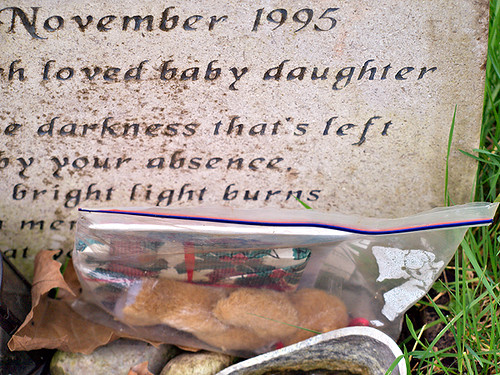
Nowadays we prefer not to inter children with grave goods but leave such offerings visible, accumulated, renewed for as long as memory or inclination might last.
I looked on as my own parents wrestled with the problem that probably no mother, no father, has prepared for, that of the funeral arrangements for their child. The result, a compromise between my intransigent and batty mother and more pragmatic father, both barely able to function through their grief, was a peculiar and inconvenient solution.
I wonder if this was why I felt particularly drawn to this monument to a young man not much older than my brother when he died. It seemed, with its combination of European and Iranian traditions and its well-tended appearance, to exude the love it declared.

The great thing about visiting a cemetery is that it gives an ideal opportunity to let ones nearest and dearest know ones own wishes. I reiterated to my children my desire to be freeze dried. It’s greener even than Highgate cemetery in all its lichened verdure.
There’s only one problem. The process seems currently only to be available in Sweden. However my offspring are both thoughtful and ingenious and, with the help of this illustrated guide, some liquid nitrogen and a big hammer I’m sure they’ll be able to do an excellent job.
(Neha’s photoset; my photoset.)





 frizzyLogic