Blogumentary

I’ve just spent, according to the timer, one hour five minutes and twenty four seconds watching this video, and it felt like five minutes. (That could have been due in part to the fact that it was seamless watching on Google video unlike my usual, frustratingly staccato, viewing experience on YouTube.)

It’s a really great documentary made by blogger Chuck Olsen about, yes, you’ve guessed it, blogs and blogging.

It’s divided into several thematic areas but the overarching importance is that of the conversational nature of blogs. At one point Chuck attempts to define blogging for his girlfriend and includes making comments as part of the activity.

Particularly interesting to me were the sections about the relationship between blogs and the mainstream media. Several times the point is made that bloggers and journalists are not the same thing. Jeff Jarvis of BuzzMachine makes the point as does Chuck himself: “I may be the media but that doesn’t mean I’m cut out to be a journalist”.

The section on Stuart Hughes‘s blog struck a big chord with me. He started blogging as a way of keeping in touch with friends and family while working as a television news producer in Northern Iraq, but soon gained a much larger and wider audience of people who found “a sense of daily life, a much more realistic and human perspective” on the events which they weren’t getting from the mainstream media.

Which is exactly where I feel blogs have so much to offer in the breaking down of prejudice and the fostering of understanding. And why the work of organisations like Global Voices is so exciting and important.

However Stuart’s story nearly ended there when he stepped on an anti-personnel mine and as a result had to have his leg amputated below the knee. He survived and his blog became “an outlet for frustration and pain”, and somewhere he found support.

As did the blog of one of Chuck’s friends when she felt suicidal.

As does mine.

If you haven’t got an hour to spare there are individual sections of footage on the left sidebar of Chuck’s Blogumentary blog.

Thanks to Krista for the link.

Combat News disTrust

Dismay at what passes for “news” in the mainstream media is nothing new.

Only a few moments ago I was reading Beth‘s account of incompletely informed reporting (whether by omission or commission) of the recent exit of eight parishes in Virginia from the Episcopal Church.

One of the best deconstructions of a news story I’ve ever read is Koranteng Ofosu-Amaah‘s dissection – in The Game of the Rough Beasts – of two articles which appeared in the New York Times on the same day. Correction. It’s *the* best deconstruction I’ve ever read. I’ve been meaning to link to it ever since I first saw it and am delighted now to have the perfect opportunity. Go and read it! you won’t regret it.

Ahem.

Back to the point at hand. Which is the launch (in beta) of a non-profit project called NewsTrust – “your guide to good journalism” – which is a media monitoring project which uses a social recommendation model like that of Digg to identify stories online which members consider worth reading – or avoiding – as explained in the “About Us” page:

In recent years, the consolidation of mainstream media, combined with the rise of opinion news and the explosion of new media outlets, have created a serious problem for democracy: many people feel they can no longer trust the news media to deliver the information they need as citizens.

To address this critical issue, NewsTrust is developing an online news rating service to help people identify quality journalism – or “news you can trust.” Our members rate the news online, based on journalistic quality, not just popularity. Our beta website and news feed feature the best and the worst news of the day, picked from hundreds of alternative and mainstream news sources.

This non-profit community effort tracks news media nationwide and helps citizens make informed decisions about democracy. Submitted stories and news sources are carefully researched and rated for balance, fairness and originality by panels of citizen reviewers, students and journalists. Their collective ratings, reviews and tags are then featured in our news feed, for online distribution by our members and partners.

So far it’s got a good-looking selection of international stories but not a good-looking selection of international reviewers, as far as my untutored eye can tell from the member directory. Let’s hope that with greater publicity the latter will change.

The Top Rated Sources page makes interesting reading. I note that Global Voices (of which I am a co-managing editor) is in the top 50 overall (and third-highest rated blog source) and that according to our NewsTrust profile page our trust rating is highish but fairness and balance are somewhat lower.

This raises an interesting issue. If I go to the Reports FAQ for NewsTrust reviewers there are the following questions posed for consideration on balance and fairness:

Balance
Q. Does it present all key viewpoints?
This rating probes whether one or more important sides to the event or issue are missing or given less space than they deserve in stories from this source. In general, the more perspectives a story includes, the fuller the picture of reality it provides. Note that most news stories only have room for the core arguments each side makes, rather than their complete point of view.

Fairness
Q. Is this story fair?
Journalists are expected to present fairly all sides of a controversy. Note this doesn’t necessarily mean equal space for all sides. The space allotted to each side should be based on the evidence for its claims and its willingness to respond. Each relevant side, however, should be afforded the opportunity to make its core argument, or decline comment.

The authors writing for Global Voices are not journalists in the definition assumed above. It is not their task to “present fairly all sides of a controversy”. They are curating blog conversations, aiming to give an insight into the preoccupations of a particular blogosphere, and just as in many other areas of life bloggers are not a representative sample of average humanity, whatever that might be.

To take just one example, brought up by our Francophone Language Editor Alice Backer at our recent summit, the vast majority of blogs on or from the Democratic Republic of Congo are written by political opponents to the government. For those denied adequate freedom of political operation and/or access to the domestic mainstream media blogs are an easy tool for people with strong opinions otherwise denied an outlet to get their voices heard.

In other words the NewsTrust definition of “fairness”, which is congruent with most serious journalistic standards of good reporting, is a difficult one to apply to our work. What we should be held to account for is, to modify the phrase I quoted above, “presenting fairly all sides of a blogosphere” which would be a far more difficult task for reviewers to evaluate accurately.

And speaking of accuracy, it’s slightly disconcerting to see two names listed on the NewsTrust page as “Authors” for Global Voices that I have never heard of before. One appears to be a US counter-terrorism analyst for a consulting firm; the other might be a prominent media analyst on the right of the American political spectrum. Neither name comes up on a search of our site. From the same Reports FAQ quoted above:

Evidence
Q. Does it provide factual evidence?
This rating examines whether this source provides verifiable, factual evidence to support its assertions. We pay particular attention to whether the right sources are quoted (authoritative quotes, appropriate statistics, documents, etc.), especially in the headline and lead paragraphs (i.e., the principal generalizations each story makes). Documents and statistics often provide more compelling evidence for a generalization than statements by individuals. Multiple sources of evidence strengthen the support, as well as independent verification by the authors that this evidence is valid.

Cough.

Anyway, I hope very much that this project expands – the concept is exciting and the aim a good one.

Blogging – according to the BBC

You would have thought, would you not, that the BBC, one of the country’s leading internet content providers, would have an online sight for a flagship programme about the internet. Your act of imagination, however, would outpace the creativity of the organisation in question.

The programme strand? The Alan Yentob vehicle Imagine. The particular episode? It was called http://www.herecomeseverybody.co.uk – A history of the World Wide Web. And yes, they went so far as to buy the domain name featured in the title, but if you go there what do you get? You used to get a redirect to the BBC 1 television listing for the day the programme was broadcast. Now, even worse, you get an error message.

How completely feeble is that? Very feeble indeed, I should say.

The programme itself wasn’t bad at all apart from the endless lingering and pseudo-arty shots of Mr Yentob used as padding for an audience the BBC obviously regards as feeble-minded and therefore incapable of consuming information without tedious and lengthy visual trickery.

They had some of the usual suspects – Tim Berners-Lee, Clay Shirky, David Weinberger, Chris Anderson of “The Long Tail” fame and a man from MIT with a very impressive but disturbingly lop-sided beard whose name I can’t remember.

The section of the programme devoted to blogging wasn’t bad… but then again it wasn’t too good either. If you removed Mr Yentob and the artsy camerawork it would have been a great deal better. In my opinion at least. Luckily you can judge for yourself since somebody’s put that section up on YouTube.

I don’t usually watch the television at all, but I knew about this programme because one of my friends, the gorgeous Natalie of Blaugustine was featured in it. We watched it, a merry band of friends and supporters, round at her house, surrounded by wine and snacks.

It was such a shame that they didn’t mention Augustine interviews God, shortly to appear in book form, but I suppose you can’t have everything. However I thought the overall blogger involvement was too short, too fragmented and rather over-quirky. But I might be a touch biased.

If you want to see quality blogger video in action, look no further than Natalie’s own thank-you to her loyal readers.


Click To Play (popup window)

I think she should work on Imagine… how about as the presenter?

Superb new search

Of course GV does have lovely shiny things of its own (see previous post if this seems cryptic).

Global Voices has a brilliant new search function. It’s in the yellow strip towards the top of the page. It’s the work of the planet-sized-brains of our tech maestros, Boris and Ethan. The latter has his own post on the heart-warming involvement of a large internet company in the development process.

Please try it out and see how it works. Feedback is warmly welcomed.

Update: Only a GV member, I hope, and as it were, would immediately think of testing the facility with this particular search.

In which I become a citizen journalist

That tornado again. I took a few snaps on my way to collect the secondborn from school and put them in a flickr set called “Tornado” with the comment “It lasted 10″ and injured 6 people but the media converged as though to some kind of national emergency.” Well, it was irritating being pounced on by reporters wanting to know what had happened “the day the sky went black”, as one of them put it. I mean, really. Was it such a slow news day?

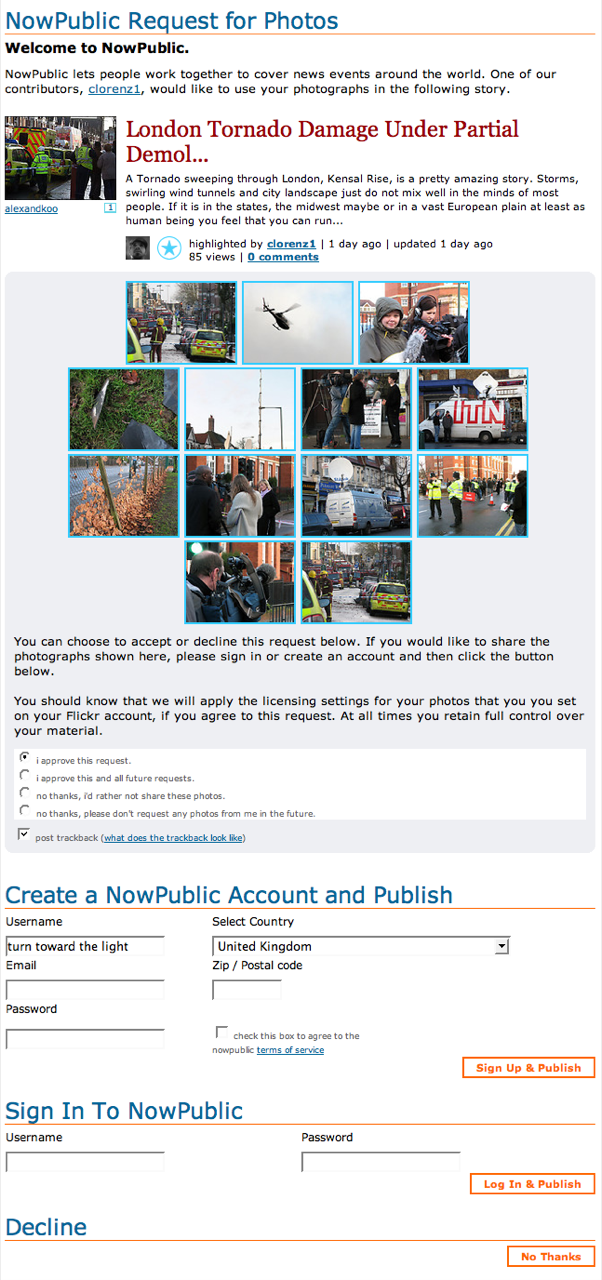
Somewhat to my surprise I subsequently received an automated invitation from the citizen journalism outfit NowPublic asking if I would care to contribute my pictures to their article on the subject.

1 invite

I’d heard that NowPublic had a whizzy automated application which allowed quick and easy importing of photos from flickr which weren’t already available under a Creative Commons license so I was intrigued to see it in action.

Clicking on the link took me directly to NowPublic’s site and the detailed form shown below (click on it for a larger version if you want to read the small print):

2 form

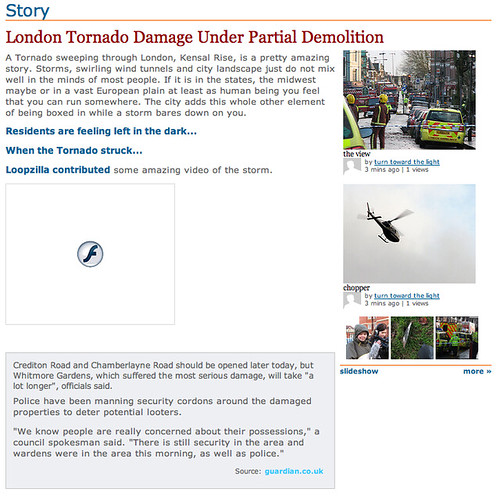
I signed on and clicked upload and lo! the story in question now had my pictures as illustration rather than the lifts from a newspaper and the BBC websites which had been there just seconds before:

3 story

(The strange box with the f in the middle is my browser’s flash animation blocker hiding a piece of video of the storm as it passed over another part of London.)

Each photograph uploaded now has a trackback to the story in which it appears added as a comment.

All very clever and nifty. The only way in which it seems not to have worked entirely as planned is the fact that of the 13 photographs selected for uploading in the original request only five made it to the site, but that may have been a deliberate throttle of which I am unaware.

So. How do we make something like this for Global Voices?

Ca existe!

The podcast for which I spoke to Alain de Botton (see Wednesday evening) is up at the openDemocracy website.

It’s available for listening or download here. Alain makes his appearance at about 14’00 in. Or, to look at it from the other end, at about 5’00 out.

It was very enjoyable doing “radio” again and the whole podcasting phenomenon is highly exciting.

Happy techno gadget love joy

When your day starts out crap there’s nothing like receiving a small (and not very expensive) bit of kit in the post.

Which, you will have correctly inferred, is what happened to me today. One of these babies plopped onto the doormat in a padded envelope. And that’s because I was so excited by the pre-launch spec that I pre-ordered.

It arrived while I was conversing (via IM) with my colleague the similarly techno-joyful Georgia, and she demanded proof of its pudding.

Thus it was that while visiting another former colleague (see previous entry for more), Kevin Anderson, who’s also a good friend of Global Voices, I shoved my new toy under his nose for demonstration purposes, reviewable here.

Not bad for something so small, I think you’ll agree. And at the low quality setting. I’m highly pleased.

And while there I was also able to take some pictures for Jeremy of the Ken Saro-Wiwa memorial sculpture about which he writes here and then here.

Hi Jeremy! Hope they give some idea of how it’s bedding down in its surroundings.

ksw1

ksw2

ksw3

ksw4

Why I am not an uber blogger

Well there are no doubt many, many reasons. But what I’m thinking of here is my colleague Ethan who went to the Pop!Tech 2006 conference and appeared to manage to blog the entire event verbatim, in real time, with witty observations and links to and discussions of others’ coverage. How does he do that?

I, on the other hand, at a small and intimate conference in Norway, find myself far more inclined to blog about the picture in the main space at the Norwegian Institute of Journalism. Here it is, all four panels.

crows.jpg

Now I find this rather ominous. Crows are considered birds of ill omen in many cultures across the globe and the bringer of the news of death.

Anyway, let’s get a little closer to the bird on the right of the picture…

crow.jpg

… still can’t see it? let’s go right close up to that wing…

wing.jpg

Yes. The harbinger of doom, the portent of death is composed of…. news(papers).

UPDATE Had I actually read through the above Wikipedia link to the end I might have worked out what I have now been told, which is that these birds are actually Hugin and Munin, raven servants to the chief god of Scandinavian mythology:

Hugin and Munin travel the world bearing news and information to Odin. Hugin is “thought” and Munin is “memory”. They are sent out at dawn to gather information and return in the evening. They perch on the god’s shoulders and whisper the news into his ears.

This sounds too much like the secret police for comfort so despite the greater relevance to journalism I still think the artist is subverting the profession. /update

So that distraction explains why I haven’t written up my notes to the (very interesting) afternoon sessions about journalism in Africa. The unvarnished outline appears, for the record, below the fold.

Continue reading “Why I am not an uber blogger”

"Are you blogging this?"

Well I am now, prompted by the question from one of the organisers.

I’m in Fredrikstad in Norway at the Norwegian Institute of Journalism conference on Free Media. (The conference will be blogged, apparently, but starting only on the second of the two days.)

The morning sessions were fascinating – veteran Nepali journalist and media activist Kanak Dixit talked about the role of journalists in the so-called Rhododendron Revolution and Babita Basnet talked about women’s participation in media.

Kanak Dixit talked about the egalitarian nature of Nepali print journalism – how everyone from a minister to a rickshaw driver might read the same paper and it would be in Nepali, not English; that the class split in journalism seen over most of South Asia (English for the aspiring middle and upper-middle classes, other languages for the rest) is not the case in Nepal where, he says, journalists are very close to the people. He asked whether journalists were leading the people in their thirst for democracy and peace or whether the people were leading the journalists.

Babita Basnet talked about the extreme under-representation of women in the media environment in Nepal but said there were more women entering the radio field which was a positive development.

Nepal has fallen off the mainstream media agenda since the events of April/May this year but Global Voices is still passing on what the bloggers are saying.

Now there is a debate entitled “Media Support, a viable path towards democracy?”. I am finding this less interesting, to be perfectly honest. A panel of three men standing up one after the other and reading prepared talks. Empower the people, say I. Citizen media. But then I would.

Panel discussion

In an institute of journalists it wouldn’t be entirely surprising for a citizen media activist to be seen as something of an enemy. I’m here to talk about Global Voices and Blogging and Democratic Values but I’ve been told journalists here are particularly interested in the “gatekeeper” role between blogs and the mainstream media. Which in some circles can be code for “will you bloggers be putting us out of a job?”

Such a contrast to last week’s conference in Hungary which I still haven’t really written about. Here there is a small lecture theatre with eight rows of seats. In Tihany we were in a converted squash hall, 1000 delegates, two large auditoriums, parallel sessions. I’m such a nooob on the conference circuit it’s all fascinating to me.

This afternoon – sessions about Africa. Off now to lunch, if there’s any left.