Hypnotic earworm

by the sea - blue

Why would this image have anything to do with an earworm?

It was the teacher’s suggestion to use blue ink to make the print. Inspired. Now the water and foam look both like water and foam and also sky and cloud. And the moon floats serenely in both.

(Let me link yet again to the absolutely brilliant poem the image was originally created to go alongside.)

Sky and clouds feature as a metaphor for conveying how we might still our minds during meditation:

The mind is like space or like sky, completely clear, not solid, and vast, spacious and unlimited.

Try to get a sense of how your mind is like that, like this clear, vast, spacious sky.

The things that we are aware of, the thoughts, images, memories and so on, are similar to the clouds that pass through the sky.

They’re not always there but they appear and after a while they disappear.

If there are thoughts appearing in your mind while you are sitting here doing this meditation, thoughts, memories, images, or if you hear sounds or feel sensations in your body, think that these are just like clouds, passing through this space or clear sky of your mind.

Let them come and let them go, realise that they are only momentary and not solid, they just come and go.

Let them go and return your awareness to the mind itself, which is like the clear spacious sky.

“You can be above your thoughts and watch them as though they were clouds below you in the sky” said my teacher.

I have a huge problem with this, though. Absolutely massive.

The problem is that the first time I was introduced to this way of conceptualising the activity (or lack of activity) someone in the group, who shall remain nameless but never forgotten, started singing Both Sides Now by Joni Mitchel:

I’ve looked at clouds from both sides now
From up and down, and still somehow
It’s cloud illusions I recall
I really don’t know clouds at all.

And every single time, yes, every. single. time. I meditate in this way I have to listen to Joni and her little ditty.

This has been amusing. Also infuriating. Boring. Enraging. Irritating like a shirt label rubbing the sensitive skin on the back of your back. Painful as an ill-fitting shoe rubbing a raw patch of skin. Frustratingly circularly self-referential as a small dog chasing its docked tail.

No doubt this is highly revealing in some way about the crapness of my mind but don’t ask me how. Nowadays I just let her twitter on, secure in the knowledge that there’s nothing I can do about it and trying to makes it worse. Maybe one day it won’t happen… and I’ll notice. And then maybe, one day, it won’t happen… and I won’t notice!

After producing a permanent pictorial reminder of a meditation closed-loop I trundled down to the IoP to take part in Dr Bell‘s research into the neuropsychology of suggestion and dissociative disorders, which was remarkably similar to the Joni effect.

I used to believe myself highly susceptible to hypnosis since a friend at university, who’d done a day’s course, managed to make me offer the assembled company hot chocolate in midsummer as a result of post-hypnotic suggestion. Of course I only have everyone else’s word for it that I was acting in a pre-programmed way since I remember nothing other than making the offer and everyone falling about laughing.

This time it was different. Although I believe I was probably hypnotised because I couldn’t, for instance, bend my arm when told it was stiff there was part of my brain which was observing everything as though from a distance. Looking at clouds from both sides now, as it were. So while I couldn’t bend my arm when told it was as stiff as a bar of iron there was part of my brain saying “hmmm, interesting. You’re trying really hard to bend your arm, genuinely trying, but you can’t. However you know that you haven’t lost the ability to move. You could do it. But you won’t because you’ve been told you can’t. Hmmm. Interesting.”

Most interesting was the post-hypnotic suggestion. I remember being told that I was going to forget everything I had been asked to do while hypnotised and then remember everything when I prompted by a certain set of words. I think I was told that I was also going to forget what I had been told. But the cloud-watching part of the brain was busy telling me that this was obviously the post-hypnotic suggestion part of the plan and was keeping tabs on what was going on.

When we were “woken up” we were asked to write down on a piece of paper what we had been doing while hypnotised. I knew that I’d been told I wouldn’t be able to remember, I also knew that I almost certainly could, but – and here’s the interesting bit (for those of you who might not find this blow-by-blow account entirely riveting) – I couldn’t activate the part of my brain necessary to recover the memory in order to write it down. In the end I had to write “I was told I wouldn’t be able to remember but I can’t remember whether I was told I wouldn’t be able to remember that or not”.

Doncha just love the human brain?

I fear my failure to be deeply hypnotised will rule me out of further opportunities to take part in the research and, most important of all to me, have a brain scan image all of my very own to play with. Rats.

So now I’m wondering what effect, if any, practising meditation has on ones suggestibility for hypnosis and whether this particular sort of dissociative activity (“mind observing mind”, unlike the pathological dissociation experienced by people with PTSD and, let it be said, certain forms of depression) is useful or otherwise.

Rhetorical wonderings, of course. But I’m glad I went and I’m glad I have the print which so serendipitously reminds me of the experience.

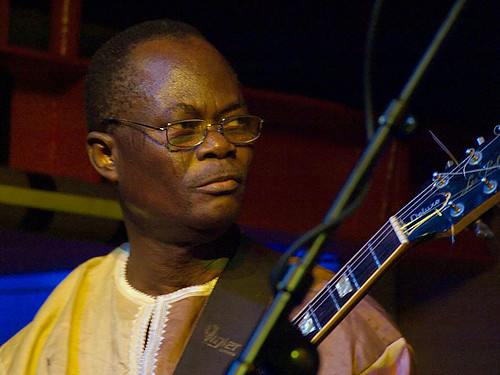
Orchestra Baobab

So the lighting was shit, the sound was disgracefully ropey for an allegedly “quality” venue – particularly since this was the third of three nights – and the floor was crowded with people of record-breaking height who all felt a desperate need to stand right in front of the stage thus blocking the view of your illicit-photo-taking correspondent. And the boys (most of whom are undoubtedly grandfathers) were taking it easy.

I had the most fantastic time. (Fan-tastic. Fan-tastic.)

cloth cap

It is difficult to overstate how much I love this band. The wonderful, sexy, mellow, sinuous, smouldering, life-affirming sound. Even the song Coumba, the lyrics of which are in French and I can therefore understand and are about the end of a relationship (written, apparently, on the day band member Rudi Gomis went to court to get a divorce from his first wife, Coumba) sounds jaunty.

Here’s my first blog reference to them back in February 2003:

Top of the spike is every track I have by Orchestra Baobab. They provide quite simply music to stay sane to. I don’t know, and don’t care what their tracks are about (my Wolof is limited to “hello how are you” and “yes”). They could be about Armageddon. But they help keep me from meltdown… Stunning. Sexy. Soulful. Syncopated. Smoochy. Sanity.

And here they are again in March 2005 when I saw them play in Dakar:

And my love for Orchestra Baobab knows no bounds. They, on my iPod, brought me through the deepest of darkness and I shall never forget how much I owe their music. I wept while they were on stage. Tears of relief and joy.

lead guitar

I didn’t cry this time, but I closed my eyes and went back to that time, of being unable to get out of bed even to take my pills only a few feet away on the mantelpiece. A time of utter desolation. Curled into a tight foetus, clutching my iPod under the pillow with this music in my ears the only sign I might still be alive.

I could see again my trainers as I walked doggedly, eyes on the ground, through the rain and mud of the winter of 2002/3 to the therapist two, three times a week, iPod clutched in a pocket, with the rhythm propelling me forward one step at a time.

And I felt profoundly grateful and happy to be there, at that moment, in that crowd, with my friends, listening to this same music and to be in such a different place. My life may be somewhat financially diminished but it is so much richer in so many fundamental respects and I feel more authentic (I can’t think of an adequate word so that will have to do) than at any other time.

skullcap sax

I’m such a fan I can actually sing along to many of the tracks even though I speak none of the various languages (apart from a little French) in which they are sung. And I did so without the slightest hint of embarrassment. After all, nobody in the overwhelmingly white, middle-aged, middle class audience was likely to pick me up on my pronunciation. But there were a few numbers I didn’t recognise and that’s because they have a new album out – Made in Dakar.

I reread the extraordinary biography of the band before writing this, and it struck me that it’s possible that one of the reasons it fell from favour was its ethnic diversity and, more particularly, the high proportion of members from Casamance, the would-be breakaway region in the south of Senegal.

bassist

I hope that their new residence in a Dakar club means such divisions are less bitter than formerly.

So the performance. Well, one of my friends thought their approach was somewhat lackadaisical. I prefer the term “laid back”. These guys are not young. They are not hungry. In fact most are rather cherubically rotund and of a placid appearance, particularly bassist Charlie Ndiaye (above) who stayed at the back of the stage with his eyes barely open  throughout, bass resting on the swell of his belly. The notable exception is ectomorphic tenor sax player, Issa Cissoko (pictured above the bassist), who is tall, whippet-skinny, deeply lined and a vigourous seeker of attention. Lead guitarist Barthélemy Attisso (above the sax player) leant over his instrument like a rather dour accountant (he was in fact a lawyer) but he’s still one hell of a player. Perhaps his demeanour is due to the heavy responsibility of the title “chef d’orchestre”.

It seemed to me that there was much good-natured camaraderie and a fair amount of clowning around poking fun at their own age and inability to dance like teenagers. It was fascinating how versatile many of them are, slipping seamlessly between various instruments and vocalist duties. And they are, of course, professional musical performers. It’s what they do, night after night, year after year, mostly in the same place, occasionally on tour. It’s a different life to the recording artists of Europe whose money comes from royalties rather than bums on seats or bellies at the bar. So there’s nothing dangerous or edgy about their performance. But the reverse has its merits – deep familiarity, confidence, relaxation, polish. Little urgency, much joy. All this and some new material too!

The rest of my pictures are here and their record label has a gorgeous gallery including wonderful pictures of them playing in Dakar in very smart suits.

A print! a print!

print

It’s so incredibly satisfying to throw back the two layers of thick fabric after the heavy roller has pressed paper to inked plate, peel the thick, damp paper sloooowly off the plate and find… an image!

That’s not actually a good representation of the print itself which is much more pleasing than that speckled result would suggest.

And here’s the small test plate (made to work out the optimum exposure time for the light-sensitive film on the plate and the length of its subsequent bath in weak acid) together with the test print.

test plate

I made three prints off the large plate of which the first was the most successful. The other two were made far too hastily because of the limited time. There is a profound and unhurried pleasure in applying the extremely viscous ink to the plate and then removing the excess carefully with scrim and newspaper. Try to rush, though, and the impatience can be seen in the end result.

I think next Saturday I am going to aim to get one more image etched to plate even if I don’t manage to print it. I’m very keen to try to take part in the hypnosis research project (mainly, it has to be said, because of the possibility of going on to have a brain scan with the associated image that would produce) but the last chance is next Saturday afternoon. My father is looking after the children so I don’t have to hurtle back.

Also I have just discovered that there is an amazing looking facility, the londonprintstudio, where I might be able to make more prints off any plates I have etched later on. Or indeed make more plates. And it’s on my side of London!

(My fingernails are ineradicably black with ink. I love it!)

Photo-etching-fiddling

Attempting to be slightly more prepared for the course tomorrow than I was last week. Most other people had brought images either on disc or paper ready to fiddle with. One had brought her laptop. I had brought a notebook and pencil and was feeling pretty chuffed for thinking of that.

So this time I have some images split into layers and already doctored somewhat as a starting point. Choosing them was a nightmare. I haven’t got the slightest problem pressing the shutter but this is a whole new deal and it’s, like, pretending to be proper art. Eeek. So I’ve been left in an agony of doubt and indecision all week.

Today I bit the bullet. God knows if they’re suitable or what they’ll look like but here they are.

First up we have the chair. Taken in Venice in 2005 when I was arts correspondent for the BBC World Service covering the Venice Biennale, on the terrace behind the British Pavilion waiting (with some trepidation) to interview Gilbert & George. They were utterly delightful and charming and, since mine was the last interview of the day, we sat and drank and chatted for ages. Possibly the loveliest interview experience of my career although there are many to choose from.

chair

Next up we have “by the sea”. This image was made to illustrate the poem Say by George Szirtes published at qarrtsiluni. Coincidentally I also interviewed George Szertes during my palmy arty days, but unfortunately over the phone. That was a lovely interview experience too. This picture was suggested as a candidate by the lovely (multi-talented) artist F.

by the sea

This image, “fishnets”, has nothing to do with my former, distant life. It’s my foot and my friend R’s hand one sunny morning under the little round bistro-style ironwork table in their sitting room. Actually I suppose that since R is a journo and I used to work with his partner H it probably does have something to do with the past. But then everything does.

fishnets

Finally we have “scream” which is making its third appearance on these pages. Originally taken with snap-buddy Neha in Epping Forest it was reworked for the spooky trees edition of the Festival of the Trees. Here it is again with a layer of red inserted.

scream

The colour could be anything I fancied, it’s a single layer and the hue can easily be changed in photoshop. The printing ink is black and we’re only making single plates but a layer of colour can be added using the chine-collé technique by which a coloured layer printed on a lightweight paper is bonded between the thicker print paper and the ink during the printing process. Or there could be no colour at all.

Right. Mustn’t forget to make a packed lunch in the morning. And go to bed early tonight. Absurd how over-excited I get about this. And how exhausted I am afterwards.

The second frost of autumn

Frost was thick on the windscreen and windows this morning. Scraping with the schoolbag left only swooping slits of visibility unaffected by the swish of the wipers. There is, of course, no form of heating in the van.

We crawled cautiously, semi-sighted, across junctions and around corners until, on the slope by the park, we turned head on toward the sun. That first lick of low light was enough to temper the ice which now slid softly sideways under the rhythm of the blades.

“Look!” exclaimed secondspawn, “I’ve never seen the windscreen so clear. It’s like it’s not there at all.”

The first frost of autumn

It crusted the car roofs in the shade, twinkled in the low orange-yellow sunlight as it slipped meltingly to gleaming.

I woke with a sense of lightness not just from the uncurtained windows. An internal buoyancy of self-belief.

This above all: to thine own self be true,
And it must follow, as the night the day,
Thou canst not then be false to any man.
Farewell; my blessing season this in thee!

Polonius was a buffoon and of course came to a perforated-lugged-guts end but the words endure.

being and not being

The earth moves, the shadows lengthen and shorten, disappear; the frost forms and melts; the water evaporates and condenses, forms clouds which quell the shadows, seed the frost. All changes. All remains the same. All is. And all is not. That is all I know, and all I need to know.

Brilliance. In two parts.

Part I. Brilliant Coroners.

I have edited a book of poetry.

What an extraordinary statement to make. Also an inaccurate one. I co-edited a book of poetry with my dear friend the Velveteen Rabbi. She did most of the work and provided the brilliance. I opted to go camping at the critical moment in circumstances where “wireless” referred to an apparatus with which one might tune in and listen to radio broadcasts using twiddly knobs rather than ethereal, fast, always-on access to the internet.

For on the internet was the project germinated, on the internet was it gestated and from the internet might it be acquired, fully formed. Or, as the information on the publisher‘s site puts it considerably more elegantly:

Writers and artists have always formed groups for mutual support, commentary, and encouragement, sometimes collaborating on public projects from group shows to hand-printed literary magazines. But while one tends to think of local writers hanging out in Paris cafés in the 1930s, or on the lower East side of New York in the 1950s, how does that desire for communication and creative inspiration translate into today’s online world? The poets and visual artists of this anthology met online through their blogs, and have corresponded for a number of years, across continents and oceans.

It’s one of the most rewarding things I have done. Printing off a great swathe of poems and reading them with minute critical attention whilst also being attuned to the writers themselves. It didn’t impede the task but rather enhanced it. So too did the knowledge of and absolute confidence in my hugely talented and experienced co-editor, Velveteen Rachel, who has an all-inclusive post about the book. It was a collaborative effort throughout with artwork, design, layout – everything you can imagine going into the production of such an object – being undertaken by members of the group. It is, on so many levels, a labour of love.

Brilliant Coronors

It’s for sale too!

Part II. d’Arbrilliance.

The wonderful and extraordinarily multi-talented Natalie d’Arbeloff  (who not only has a poem in the volume above but of course has also recently published The God Interviewshas just won a prestigious competition, to celebrate 50 years of the Guardian‘s women’s pages. See Natalie’s accounts by scrolling down to entries for 5, 7, 8 and 10 November. And for her pain (that inflicted by the party boots) she gets to edit the section for a week. I can hardly wait to see what she’s going to do. And what she thinks of the experience.

I like the movement implied in these two disparate shining things. The interplay between “old” media and “new”. Writers and artists exploring “new” ways to produce and distribute an “old” media product; a writer and artist immersed in the “new” bringing her talents to the “old”.

Photo-etching course

oil can

Above are the vital accoutrements of the etching press snugly attached to its inside leg.

I didn’t get to make a plate today, the first of the three Saturdays of the course, but learnt a great deal about preparing images in Photoshop for the etching process. Fascinating. I’m (badly) self-taught on Photoshop Elements. It was a real education seeing the full programme used by a professional.

Most interesting about the overall process is the conjunction of ancient and modern. The computer high-techery brought together with such centuries-old pieces of equipment as powdered resin and feathers.

In the course of this week I’m going to prepare a couple of images on the computer here at home in the hopes that I’ll be able to make a plate and a decent print next time.

Frizzy photography

There is an additional variable to be taken into account if one takes pictures and has unruly hair. Not only is the direction of the light important, so is that of the wind.

frizzy hair, following wind

Those bits above are the particularly self-willed sections which, despite the locks being firmly brushed and fettered, insist on their freedom. With a brisk following wind such as there was this morning my already deteriorating sight is further obscured by a frizzy filter.

Not only sight. The “finger in front of the lens” problem easily encountered when using a small camera is compounded by the “entire picture obscured by hair” effect. On one side of the frame the grotesque balloon of a giant out-of-focus digit complete with disturbing close-up of its nail, on the other side a smear of some sort of striated material like bleached washed-up seaweed.

Luckily my lens is as proud and phallic as a trumpet so only the very longest wayward clumps make their way into the edges of pictures nowadays, unless I set out to capture them. And, I confess, I have sometimes used photoshop to remove the evidence.

The sky was profoundly, glintingly, infinitely blue this morning. The sun was low but strong.

sunlit whippet

The dogs enjoyed their walk.

“This is the world’s largest collection of anatomically correct fabric brain art”

So goes the opening line of at the web site of The Museum of Fabric Brain Art. It’s probably safe (but I can’t prove it) to say it’s the world’s only collection of anatomically correct fabric brain art. “As featured in Science and Knitting Help“.

This is just too exquisitely wonderful for words. Science and Knitting Help. Juxtapositions don’t get much better than that.

There’s a knitted brain, ffs. With a zip. At the corpus collosum. (So it says on this site which has more information about the artwork in question and an accompanying animation and poster. I would have just said that the hemispheres can be zipped together.)

Apparently Karen Norburg “began knitting a brain to kill time when she was undergoing clinical training in child psychiatry”. She’s also a Medical Research Fellow, when she’s not knitting. “Building a brain with yarn and knitting needles turns out to follow many of the same pathways as actual brain development,” she says.

That is so many kinds of holy wow I’ve actually lost count.

The original link is from the ever-gorgeous Mind Hacks. I’m really profoundly pissed off to be unavailable to be a participant in Mr Mind Hacks (aka Vaughan)’s research. The dates for volunteers to do their stuff are exactly those of my long-anticipated photo-etching course. To think, I might have been in with the chance of a brain scan all of my very own. Dammit dammit dammit!